



Mangalsala trails
Day 1.
6 km
First day
Practical info
jljljlkjlkjlk
Sights
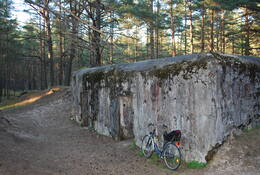
Fortification of the Latvian Army Sapper Regiment
It is located in Riga, Mangaļsalai at the mouth of the Daugava in the sea opposite Daugavgrīva.
The Latvian Army's reinforced concrete fortification, or kaponieris, was an element of the Latvian Army's coastal defense system. It was built by the soldiers of the Sapieru regiment in 1928. Designed for shooting the enemy with machine guns in two different directions. It was secretive, hard to see and not marked on maps.
After the War of Independence of Latvia, Mangaļsala was formed as a fortified area of the Latvian army to stop potential attacks of the enemy, including landings. The intention was to enhance the effectiveness of weapons by taking advantage of special structures and terrain. Reinforced concrete fortifications were able to protect soldiers and weapons during the battle, and also allowed to control the territory with small forces. Mangaļsala was home to a Latvian army radio station and coastal defense artillery.
Nowadays, you can see a rare and well-preserved fortification in Latvia. In the territory of the seaside forest, you can see other fortification structures. A place with huge potential still waiting for revival.
Audio guide https://izi.travel/en/edbf-mangalsala-fortifications/en
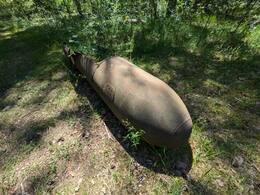
Remnants of training torpedoes
According to eyewitness accounts, the Soviet army stored ammunition on Mangalsala very carelessly, which could have been the cause of man-made disasters. Ammunition had been stored in this area since the time of Tsarist Russia – in both closed and open-type storage facilities. During the Soviet era, ammunition and naval mine warehouses of the USSR Baltic Fleet were located here. There was supposedly a torpedo workshop in Daugavgrīva.
“In Mangaļi, Riga District, where our mine and torpedo warehouse was located, 400 thousand tons of explosives were stored. (…) In addition, the warehouse stored hundreds of torpedoes, sea mines, fuse-detonated explosive charges and all sorts of other explosive junk. There was also a charge deactivation workshop. And a whole pile of small arms – from SKS carbines to “Parabellum” pistols,” writes former officer – Captain 2nd Rank Andrejs Riskins.
Nowadays, the "torpedoes" seen in the forest are training torpedo hulls cast in concrete.
Railway branch and platform
Around 1958, a special railway branch was built on Mangaļsala from the Vecāķi station for the needs of the Soviet army. It was the most convenient way to bring fuel, ammunition, firearms and building materials to the military base located here. Even earlier, starting from the 20th century and up to the Soviet years, a narrow-gauge railway ran through the entire Mangaļsala, transporting ammunition to the gun emplacements. Later, a more serious railway branch was built, crossing the Vecdaugava over one of the two – the least known – dams on Mangaļsala. For example, it is no longer possible to access this dam from the Vecāķi side, because the view is blocked by private property. The concrete hillock visible in nature was a platform. When Soviet troops left Latvia in the early 1990s, 600 wagons with approximately 30 tons of ammunition were transported along this railway. It is said that at that time it was done in such a hurry and so carelessly that "the whole of Riga could have been seen in the air". Or at least a certain Riga neighborhood. Shortly afterwards, the railway was dismantled.
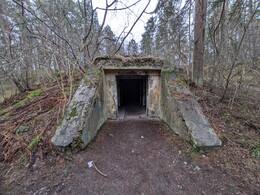
Closed ammunition depots built in the 1950s
In the 1950s, such a bunker was built and covered with earth so that a potential enemy could not find it so easily. There are four such buildings in Mangalsala in total, all of which were built between 1953 and 1955. During the Soviet era, ammunition was stored here - underwater mines, torpedoes, etc. Currently, this is the cleanest of the closed-type ammunition depots from the Soviet era, but if you go further, you can also see the largest one.
Attention! To protect hibernating bats (all species are protected), do not move underground and inside bunkers from October to April.
Open ammunition depots, lightning conductors, wells
During the Soviet era, so much ammunition and military equipment was brought to Mangaļsala that there was not enough space in the warehouses, so a large part of it had to be stored in the open air. Only such things that could be damaged by moisture were placed in the premises. This action also shows the careless attitude of the Soviet army towards any kind of inventory: a sandbank was built around it, of which a small hillock still remains, but the bank itself protected the ammunition from fires and explosions. If a rocket were to explode in the vicinity here, the blast wave would hit the bank and would not reach further, or would reach a much smaller extent. Nearby is a reinforced concrete pole - a lightning rod! Such poles allowed to protect ammunition from lightning strikes. Similar poles can be observed in other places. Former water wells are also visible, so that if necessary, something could be extinguished. In general, information about the Mangalsala ammunition depots was very secret - even on old Soviet military maps these places are marked as pioneer camps. Approximately 50 meters behind the embankment is another concrete bunker.
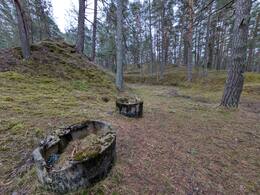
Projectile warehouses
This building was built between 1876 and 1885, when Tsar Alexander II and after him Tsar Alexander III ruled here. It is worth paying attention to the facade of the building with cornices and window openings, etc. decorative forms. This building was used as a warehouse where cannon shells were stored. Approximately 300 meters from here there is another such warehouse, which even has beautiful, curved window grilles. Similar red brick military buildings can still be found here and there in Latvia - for example, in Liepāja Karosta. All the red brick buildings on the territory of Mangaļsala were built at about the same time. At that time, the political situation in Europe was complicated, and the Russian Empire began to militarily strengthen its Western border. The building has a double outer wall and air circulates between the walls, which not only creates additional ventilation, ensuring the necessary temperature and humidity level in the building, but is also able to cushion the explosion. In the event of a large explosion, the outer wall collapses, but the inner one remains intact, protecting what is inside the building. On top of the bunkers on the other side of Mangaļsalas Street, there were mortar positions. During the time of free Latvia – in 1926 – anti-aircraft guns, or cannons that move on wheels, were placed instead of mortars! Not far from here is one of the thickest pine trees in Riga. Moreover, it is not only thick and large, but also wounded – bullet marks can be found on the pine trunk. In what battles the pine suffered – it is unknown!
Attention! To protect hibernating bats (all species are protected), do not move underground and inside bunkers from October to April.
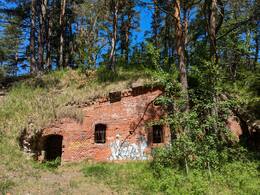
Chemical warehouse and bypass road
This bunker was built in 1955 – during the Soviet occupation. The path around this building was once a bypass road, surrounded by a double barbed wire fence. Guards walked behind it and watched to see if any unauthorized person approached the facility. This building is mentioned in some sources as an ammunition depot, and in others – a chemical storage facility. It is said that there were even nuclear missiles here, but no traces of radiation have been found here. It is completely dark inside, but then, light is visible. It was once a ventilation system. This is the only building on Mangalsala that had ventilation. Cargo was brought here by wagons along the railway. The acoustics are very good – once a youth choir even had a rehearsal here! However, here and there, graffiti art works are placed on the walls of the building.
Attention! To protect hibernating bats (all species are protected), do not move underground and inside bunkers from October to April.
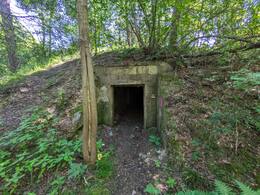
Mangaļsala Fortifications
Coastal fortifications are located in Riga, Mangaļsala, at the mouth of the Daugava across from Daugavgrīva. Fortifications built by different armies (Russian, Latvian, German and Soviet) can be seen here. The fortifications of Mangaļsala were built to defend the city of Riga from hostile navies. This area was strategically important for a long period of time. After World War I the Latvian Army did not yet have a strong navy. The maritime border was long and coastal defence was becoming an increasingly difficult task. The Latvian Army took over the fortifications built by the Russian Empire in the end of the 19th century and beginning of the 20th century and expanded the defence system. The artillery of Daugavgrīva and Mangaļsala would open fire on enemy ships trying to enter the mouth of Daugava, while support points at the mouth of Lielupe (Jūrmala) and mouth of Gauja (Carnikava) would stop enemy landing parties. There was also a specially equipped armoured coastal defence train that could provide artillery fire and support in the direction of Saulkrasti or Jūrmala. The aim of fortifying strategic sites was to maximise the use of weapons through special constructions and terrain advantages. Coastal defence fortifications were spread out over a large area to counter enemy efforts in the event of war.
Audio guide https://izi.travel/en/edbf-mangalsala-fortifications/en
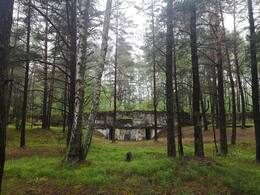
Latvian Army Spotlight Point
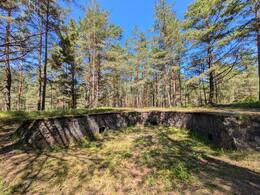
The peculiar horseshoe-shaped concrete structure was once the location of a searchlight. Meanwhile, a hundred meters further towards Vecāķi, a searchlight helmsman sat in a small concrete bunker and watched for any unauthorized person approaching from the coastal side. There were practically no trees here, so the entire area was clearly visible. If an attacker started shooting at the light source, the helmsman would be completely protected – submerged in the cover of darkness and concrete. This searchlight point was built by the Latvian army in 1928, continuing to adapt the already militarized Mangaļsala to its needs. Later, during the Soviet occupation, the searchlight could also be used to watch for anyone intending to go in the opposite direction and flee to the “wild west”. Leaving the country without permission was prohibited. In addition to security, the coastal sand was also plowed up so that the tracks of illegal immigrants or pedestrians could be seen.
Mangalsala Street
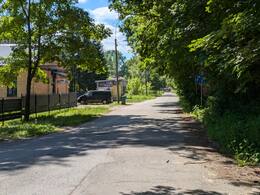
At the end of the 19th century, fortifications began to be built on Mangaļsala, and with them this paved road was also created, because it was practically impossible for heavy trucks to move on the dry and fine sand of Mangaļsala. Previously, the paved road led from the Vecdaugava dam (this is the place where you enter Mangaļsala from the Vecāķi side) all the way to the army dock on the bank of the Daugava. Unfortunately, a large part of the pavement was appropriated by unscrupulous people over time, so this road is no longer safe for driving with passenger cars in several sections. Part of the paved part was once covered with asphalt.
Eastern (Mangalsala) Pier
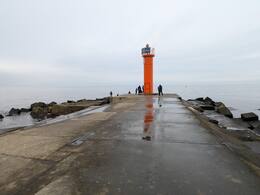
Both piers on the Daugava are closely connected with military events and history. They were built at the end of the 19th century to reduce the clogging of the river mouth and regulate the flow, thereby ensuring shipping and at the same time - the protection of the Daugava mouth. Their strategic importance was associated with the protection of Riga as an important port and military base.
During World War I and the Latvian War of Independence, the area around the mouth of the Daugava River was a zone of military operations. During World War II, the piers were of great strategic importance, as they helped control the approach to Riga from the sea.
The pier is based on a wooden pile structure covered with stones. The pier is approximately one kilometer long.
Although today the Daugava piers are mainly used as a walking area and a historical site, their historical connection to military strategy and the protection of sea routes is an important aspect of Latvian history.
Caution! The surface of the pier can be slippery. Visiting it during strong winds and storms is dangerous!
Lady Kathleen's story of a wreck visible from the shore.