


Border towns of two countries - Valka and Valga
Exhibition “Valka - the Cradle of Latvia’s Independence”
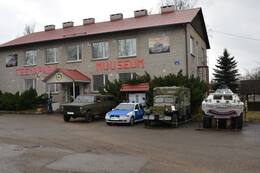
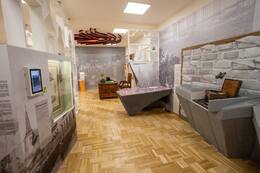
The Valka Local History Museum is located in Valka, on the right side of Rīgas street, in the historical building of the Vidzeme Parish School Teacher Training Seminary. From 1853 to 1890, the building was home to the Vidzeme Parish School Teacher Training Seminary. Until 1881, it was led by Jānis Cimze, a teacher and founder of Latvian choir culture. After the School Teacher Training Seminary was closed, the building served various educational, cultural and household needs for 80 years. The building has been home to the Valka Local History Museum since 1970. The museum’s permanent exhibit – ‘Valka, the Cradle of Latvia’s Independence’ – has been set up as a story about social and political events in Valka from 1914 to 1920 when Latvia became an independent state. The exhibit reflects the preparation leading up to the establishment of the Latvian state and the formation of the North Latvian Brigade in Valka. Through four senses, namely, the Road, the Council, the Headquarters and the Home, the exhibit focuses on topics related to the city of Valka, refugees, the founding of the Latvian Farmers’ Union (1917), the
Latvian Provisional National Council (1917), the Latvian Provisional National Theatre (1918), the Provisional Government of Soviet Latvia known as the Iskolat, the North Latvian Brigade (1919) and General Pēteris Radziņš. In addition to the traditional ways of showcasing collections, the exhibit makes use of interactive multimedia solutions.
Underground Military Bunkers in Valka
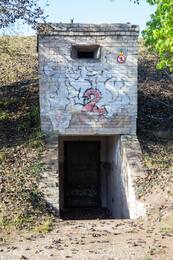
The Valka bunkers are located in the centre of the city of Valka, on the left side of Ausekļa street, next to the Ādams Tērauds School. Visitors can only view the bunkers from the outside. The Soviet Army bunkers in Valka were among the most secret places in Soviet Latvia only accessible to people with special permits. From 1953 to 1989, they were home to the Soviet Army’s strategic missile communications reserve. Large 16 wheelers were used to deliver massive reinforced concrete blocks for building the bunkers. Once completed, all three bunkers were covered with gravel for additional reinforcement and insulation. The bunkers housed a strategic missile communications reserve subordinated to the Leningrad Communications Centre. Silos with army missiles were controlled from these bunkers. There were 20 such silos in the Valka and Valga area. In October 1962, during the Cuban Missile Crisis, these missiles were combat-ready and aimed at Florida. Legend has it that they were a couple of hours shy from actually being launched. Right next to the Ādams Tērauds School and the underground bunkers is the Swedish (Sheremetyevo) Fortification. The artificial wall of earth was built at the beginning of the Great Northern War, around 1702, to protect Valka against the Swedes. The steepest wall of the fortification faces the village of Ērģeme, while the other side faces Ausekļa street.
Valga railway station built by German prisoners of war
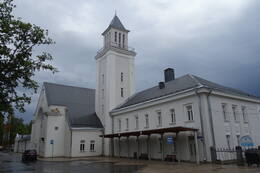
The main building of Valga railway station (Leningrad Transport Planning Office, architect: Viktor Tsipulin) was completed in 1949. It is an elongated two-storey structure with an avant-corps and a hipped roof, its architectural showpiece being its seven-storey square tower. It is one of the best and most remarkable examples of Stalinist architecture in Estonia. Its original state having been so well preserved further elevates its significance. The railway station was built shortly after World War II in place of a building from the imperial era that Soviet bombing had razed to the ground. Since German prisoners of war were detained in Valga, it is plausible that they were used to construct it.
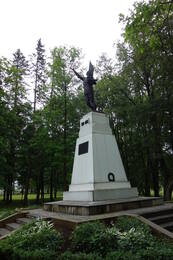
Monument to the War of Independence in Valga
This monument, in remembrance of freedom fighters from Southern Estonia, depicts a statue of an unknown soldier, his sword sheathed, holding a flag in one hand and the other outstretched, standing on top of a tall plinth. The original monument was unveiled on the 31st birthday of Lieutenant Julius Kuperjanov on 11 October 1925, but was demolished by the Soviet regime on the night of 21 September 1940. It was unveiled anew at its original location on Kuperjanovi Street in Valga on 16 August 2013. The original monument was designed in 1925 by Amandus Adamson, who also oversaw the bronze sculpture's casting in Italy. It was restored to its full size by sculptor Jaak Soans. The restoration was organised by the non-profit organisation VIKP (Permanent Exhibition of Patriotic Education in Valga), the town and county government of Valga and the Estonian War Museum.
Valga Military Museum – Theme Park
This museum and theme park showcases the internal security and military history of Valga and Estonia. The place is perfect for organising summer camps with field activities and a field trip to a World War II battle site near the Väike-Emajõgi River. The programme includes learning to cook pea soup (a popular dish in the military), using camouflage face paints and orienteering in the woods.
The exhibition at the theme park includes military equipment, artillery, an Mi-8 helicopter, a fire engine and various types of machine gun pillbox and naval mine. The tour ends at a Forest Brothers’ bunker, where, on prior request, an alcoholic beverage drunk by the Forest Brothers and smoked lard sandwiches with onion are served. For more serious enthusiasts, the museum displays the largest collection of weapons in Estonia. The Estonian Defence Forces, Police and Border Guard Board, Defence League and Internal Security Service organise demonstrations at the museum of the duties they carry out. They are joined in doing so by the Latvian Police, Border Guard and Fire and Rescue Services.