


Karosta - a city within a city
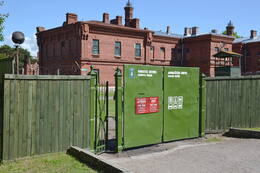
Karosta Military Prison
Karosta Prison is a unique historical and tourist attraction in Liepāja, allowing visitors to learn about the more than century-old history of the military prison and the fates of those imprisoned there. The building was built around 1900 and served as a place of disciplinary punishment for military personnel until 1997.
From the very beginning, it has been a gloomy place for breaking people's destinies and suppressing free spirits. Various unexplained phenomena have been observed in the prison - knocking footsteps, electric bulbs unscrewing themselves, closed cells opening, and apparent images appearing in the corridors.
Today it is an important cultural and historical object that allows you to get to know the military history of Latvia and preserves memories of people's destinies at different stages of history. This is not an ordinary museum tour - it is a story about people's destinies and the harsh reality of history. During the tour, you have the opportunity to see the prison, which has remained almost unchanged since the times of the Tsar. Hear stories about the history of Karosta and unusual events from the daily lives of prisoners. Enter the cells and the solitary confinement, looking into the darkest places of the prison. Get to know the exhibitions about World War II, the Kurelians and the Soviet era.
Karosta Prison is not just a tourist attraction – it is a living witness to history.
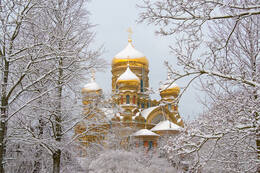
Karosta St.Nicholas Orthodox Sea Cathedral
The St Nicholas Orthodox Sea Cathedral is the visual and spiritual dominant feature of the Karosta, in stark contrast to the high-rise prefabricated housing built next to it. The church was designed and built according to the principle of 17th century Russian Orthodox churches, with one central and four side domes.
A representative cathedral was already envisaged at the time of the design of the port complex by Emperor Alexander III, but initially the port infrastructure took priority. A temporary Orthodox church was in operation from the beginning in the area of the port hospital.
Construction of the St Nicholas Maritime Cathedral began in 1900 to a design by the architect Vasily Kasyakov, which was very similar to other sacred buildings of the Russian Empire of the time. The cathedral was consecrated on 22 August 1903 and was attended by Emperor Nicholas II of Russia and his family. Until 1915, the cathedral hosted all the ceremonial events of the Russian army and navy, including the service of the 2nd Pacific Squadron in 1904 before it sailed to the Far East, where it was destroyed in the Battle of Tsushima.
After 1915, when Liepāja was occupied by German troops, the cathedral retained its sacred status and partly its furnishings, with rare services held there.
After the Latvian army garrisoned Liepāja in the territory of the Karosta, the cathedral continued to function as an Orthodox church until 1934, when it was converted into a Lutheran church for the Liepāja garrison. The church was redecorated, including the replacement of the crosses, and the three major denominations - Lutheran, Catholic and Orthodox - were able to hold services there. One Orthodox altar was retained in the cathedral, and in the late 1930s an electric organ manufactured in VEF was installed for Lutheran services.
During the Soviet military base in 1939-1941, the cathedral lost its sacred status, and during the Second World War the building was also used by various German units.
After the Second World War, the Soviet naval base authorities established a matrons' club in the cathedral and the building was converted to its new function.
In September 1991, while the Russian Federation was still in operation, the cathedral was restored to its historic name and handed over to the Orthodox Church. The first service was held on 19 December 1991 in honour of Saint Nicholas. In September 2016, the restored cathedral bells were consecrated.
Liepāja Northern Fort and Battery Nr.1 in Karosta
The Northern Forts are the best known and visually most impressive part of the Liepāja Fortress. Built by the Russian tsarist army in the late 19th century, their historical name is Fortress Battery No 1.
In November 1908, less than 10 years after its construction, the Liepāja Fortress ceased to operate, because its construction was acknowledged as a strategic mistake. Some of the cannons were dismantled and taken to the Kaunas Fortress in Lithuania, while others were remelted. Fortification structures were detonated twice in an attempt to destroy the fortifications. Elements surviving to the present day include artillery batteries not fully destroyed in the explosions and underground structures. Just like the Karosta, the Northern Forts were a closed military territory during the Soviet occupation. Visitors to the Northern Forts should be very careful. As in other places on the Latvian coast, the steep shore of the Baltic Sea in the Karosta is dangerous due to potential coastal landslides. Therefore, it is not allowed to walk under the ruins of the forts.
In the northern part of the fortress was located one of the four coastal defence batteries, Battery No.1. The battery was to house six 6-inch (152 mm) guns of the 1892 model of the Canet system, six 11-inch (280 mm) guns of the 1887 model and two 57 mm Nordenfeld anti-ship guns. Only the guns of the Canet system had a long enough firing range to withstand possible shelling by the German Navy. Thus, at the time of the liquidation of the fortress, the armament was only partially installed.
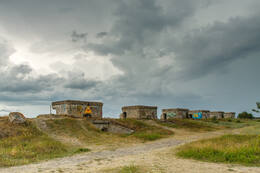
Redan of Karosta Fortifications
Redans, or Redana Fort, is located in Karosta, 14. novembra Street, about 1.5 km from the Northern Forts, in the nature reserve "Tosmare".
Historically, redans were elements of fortifications where longer sections of fortress walls were divided into shorter sections by building V-shaped positions facing the enemy, which allowed for better protection of the fortification wall. Karostas Redan is a late 19th century Liepaja Sea Fortress, projecting towards Lake Tosmare. As the fortress lost its fortress role, the fortifications and forts around it were partially blown up and rendered unusable. However, Redan remained almost intact.
In November 1919, after the failure at Riga, Pavel-Bermont Avalov's forces launched an intensive attack on Liepaja. The battle was also fought at Redan, where 80 soldiers of the Liepaja Military Port Commandant's Office under the command of Lieutenant Commander Radzins fought. In a swift attack on 14 November, the Bermontians managed to take Redan. This was followed by a counter-attack by Latvian troops and Redan was retaken.
In June, July and August, a knowledgeable guide will be waiting at Redan every day from 11.00-17.00, ready to tell you more about Liepāja Fortress and the historical events in the Karosta.
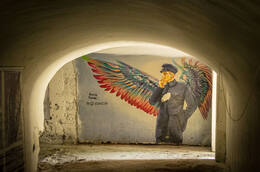
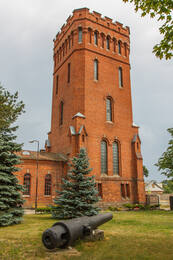
Karosta Water Tower
The water tower is located in Liepaja, in the Karosta, at 29 General Baloža Street - where the street meets Lazaretes Street. The water tower was an important building in the Karosta, as it supplied almost the entire Karosta area with drinking water. The exact time of construction of the water tower is unknown, but it could have been between 1903 and 1905. The project was probably designed by the St Petersburg architect Stefan Galenzovsky.
The water tower was powered by a steam engine with two coal boilers, one of which was kept in reserve, so there is an equally tall chimney next to the tower. The transmission powered four pumps, two of which were kept in reserve. Four boreholes supplied water to the pumps, which pumped it to a reservoir on the fifth floor of the tower and from there to the officers' apartments and soldiers' barracks in the Karosta.
When the Latvian Army took over the management of the water tower, the Ministry of War also took over the management of the water tower. After the Second World War, the Soviet Army took over the management. The water tower has been closed since 1989.
Although the tower was not a military building, in November 1919 the Latvian Army corrected the artillery fire of the British warships in the fight against the attack of the Bermont troops.
https://industrialheritage.travel/lv/objects/karostas-udenstornis/51