


Military Heritage in Vidzeme: Freedom Struggles, Legionnaires, Forest Brothers and Deportations
Historic Exhibition "Burning Conscience"
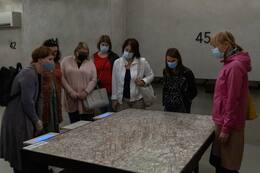
The historical exhibit ‘Fire of Conscience’ is located in Cēsis, near the Cēsis Castle Square. Established in a Soviet-era temporary detention facility, it tells about the occupation of Latvia and reveals surprising and heroic stories of resistance from individuals. The yard features a memorial wall with the names of 643 residents of the former Cēsis district who died in Soviet repressions, including national partisans deported in 1941 and 1949 and those shot and sentenced to death. The exhibit’s timeline encourages visitors to study the course of the occupation of Latvia from 1939 to 1957. Arranged by topics, quotes from local newspapers offer a comparison of the political propaganda of the two occupation regimes. The six cells for temporary detention have survived to the present day in their original form from 1940 to 1941 and the post-war years. Here, the residents of Cēsis district, detained for various anti-Soviet activities, including national partisans, their supporters, young people who distributed anti-Soviet leaflets and other ‘traitors of the motherland’, were held for several days during the initial investigation and interrogation before being sent to the main KGB Building in Riga. Everything here is real: cells with iron doors, built-in ‘kormushkas’ (small openings for providing food), plank beds, a latrine for detainees, a small kitchen with an oven, as well as typical Soviet-era oil paint on the walls. In 2019, the exhibit was ranked third in the national design competition, the Latvian Design of the Year Award.
In Cēsis - Monument to the Soldiers of the Student Company Fallen in the Battles of Cēsis
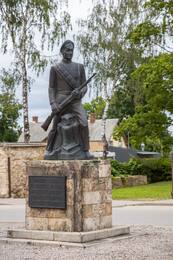
The monument to the soldiers of the Cēsis Regiment Students’ Company who died in the Battles of Cēsis is located in the city of Cēsis, near the intersection of Palasta and Bērzaines streets. The construction of the monument was proposed by the Soldiers’ Association of the Cēsis Regiment Students’ Company. The monument was unveiled on 26 May 1938. The monument is based on the idea sketched by artist Jānis Rozenbergs, a former soldier of the company. Placed on a metre-high limestone pedestal, the 1.8-metre copper sculpture of a soldier dressed in a school student’s uniform was created by sculptor Rūdolfs Āboltiņš and coppersmith Jānis Zibens. An owl, a symbol of wisdom and knowledge, lies at the soldier’s feet, squatting on and protecting the books of a student who went to war. The sculpture was demolished during the Soviet re-occupation in 1952. A monument named the Komsomol Flag Bearer by sculptor Kārlis Jansons was erected near its former location in 1957. Placed near its historic site, the restored monument was unveiled on 11 November 1992. At the same time, in 1992, a monument to the Komsomol, which had been erected by the occupation regime, was taken down.
"Mežabrāļi" - National Partisan Bunker
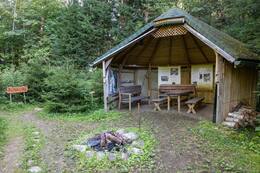
The Forest Brothers’ Bunker is located by the Riga-Pskov (A2) highway 76 kilometres from Riga and 11 kilometres from Cēsis. The Latvian national partisans or Forest Brothers were small, armed groups of local residents who fought their independent battles against the occupation regime of the USSR in the territory of Latvia from 1944 to 1956. Forced to hide in the forests, these were people who could not or did not want to live in the Soviet Union. A total of around 20,193 Forest Brothers operated in Latvia. The bunker was formed based on the stories and memories of former Forest Brothers about life in the forests, hiding and fighting for the independent state of Latvia after 1945. The bunker showcases armaments and household items. The personal belongings, weapons and photos of partisans are on display. The guide’s narration is enriched by a video from interviews with Forest Brothers. There is a place for picnic campfires by the bunker. It is possible to pre-order a soup prepared on the fire or enjoy an evening of outdoor cinema by the fire.
Virtual reality binoculars "Battle of Cēsis"
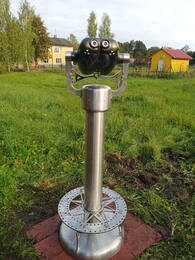
The Battle of Cēsis was one of the most significant turning points in the course of the Latvian War of Independence (1918 - 1920). On June 5, 1919, with a clash between armored trains of the Estonian Army and Landeswehr units near the Ieriķi railway station at the bridge over the Amata, the first stage of the Battle of Cēsis began. In commemoration of this event, a tourist attraction has been created near the Ieriķi station, which offers to experience the story of history using the possibilities of modern technology - with the help of virtual reality. The five-minute video “BATTLE AT THE BRIDGE OVER THE AMATA” can be viewed for free every day in virtual reality binoculars. Video duration: 5 min., LV with subtitles LV, ENG, EST and ES.
Museum of Melānija Vanaga and Siberian dugout
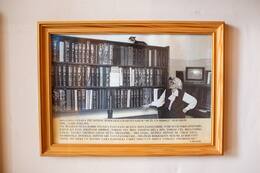
The Melānija Vanaga Museum is located in the Amata village school in Cēsis municipality. The museum showcases materials about the life, literary activity, family and destiny of writer and cultural historian Melānija Vanaga: video content about Siberia and the deported Latvians living there and a Siberian dugout taking its visitors on a trip to the writer’s place of deportation in Tyukhtetsky district, Krasnoyarsk region. The appearance and layout of the dugout form a realistic idea of life away from home. The dugout features unique historical objects brought there from the Tyukhtet Museum: a birch-bark dish known as ‘tuyesok’, a clay mug known as ‘krynka’ and a kerosene lamp. The museum features video interviews with politically repressed people from the municipality and 18 characters from Melānija Vanaga’s book Suddenly, a Criminal: Sixteen Years in Siberia. The museum’s virtual exhibition ‘BE YOURSELF!’ (http://esipats.lv) shows the experiences of five deported children and their parents who were wrongly accused by the Soviet authorities of ‘betrayal of the motherland’.
In Cēsis - Victory Monument to Latvians and Estonians Fallen in the Battles of Cēsis
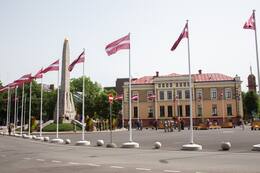
The Victory Monument to Latvians and Estonians killed in the Battles of Cēsis is located in the city of Cēsis, on Vienības Square. In honour of the participants of the 1919 Battles of Cēsis, on 22 June 1924, the first stone was laid for the Victory Monument as sketched by architect Pauls Kundziņš, using funds donated by the people. During the Soviet occupation regime, on the night of 25 March 1951, the monument was blown up and taken down completely. A monument to Lenin, created by sculptor Kārlis Jansons, stood on the former Victory (Unity) Square from 1959 to 1990. In 1997, Māris Niklass, chairperson of the Cēsis District Council, managed to involve Estonian state institutions in the restoration of the monument. The material needed for the construction of the monument, Saaremaa dolomite, was received from Estonia as a gift. On 22 June 1998, during the celebrations of the 79th anniversary of the Battles of Cēsis, the first stone of the monument to be restored was laid on Vienības Square. A ceremony to unveil the restored Victory Monument took place in Cēsis on 15 November 1998 (author: architect Imants Timermanis). Information about the Victory Monument is available in the ‘Cēsis and the Latvian War of Independence’ exhibit of the Cēsis History and Art Museum, in the New Castle.