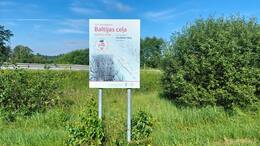

По Балтийскому пути от Вильнюса до Риги
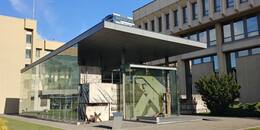
13 января Мемориал Сейма Литовской Республики
Памятник расположен в Вильнюсе, перед Вторым Дворцом Сейма Литовской Республики. В январе 1991 года народ Литвы окружил Дворец Сейма баррикадами, борясь за свою свободу и защищая ее. Это была попытка защитить Литву от военной агрессии Советского Союза того времени — попытки СССР совершить государственный переворот в Литве и восстановить советскую власть. Баррикады окружали здание Парламента до конца 1992 года. В 1993 году перед Дворцом Сейма Литовской Республики был воздвигнут уникальный мемориал, сделанный из частей баррикад и других реликвий, — он был посвящен литовскому народу, отдавшему свои жизни за свободу. 13 января 1991 года произошли трагические события: Советская Армия и спецназ заняли здание Литовского радио и телевидения и телевизионную башню, в результате чего погибли 14 борцов за свободу и около 600 человек получили ранения. В преддверии десятой годовщины Дня защитников свободы было принято решение сохранить композицию, создав мемориал к 13 января. Мемориал был открыт в 2008 году. В мемориале сохранился подлинный фрагмент парламентских баррикад 1991 года, а также часовня с иконой Пресвятой Богородицы. В мемориале представлены предметы, принесённые людьми, которые дают представление о событиях, произошедших во время защиты независимости Литвы.
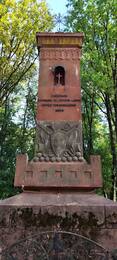
Памятник воинам, павшим за свободу Литвы в 1920 году
Памятник находится в Гедрайчяе.
19 июня 1932 года в Гедрайчяй был открыт памятник павшим литовским борцам за свободу. Инициаторами строительства памятника выступили жители Гедрайчяй – художник и автор памятника Антанас Ярошявичюс, пастор Мейгис, Мальвина Валейкене и Матас Валейка, поддерживавшие литовских воинов в боях, а также жители Ширвинта и Литовская армия. На строительство памятника было собрано 11 000 литов. В призыве к пожертвованиям на памятник говорится, что он возводится «в честь победы и нашей вечной радости, чтобы напомнить нам об историческом значении этого места и воздать должное воинам, похороненным в Гедрайчяй». Церемония открытия была пышной. В церемонии приняли участие Президент Литовской Республики А. Сметона – Главнокомандующий Вооружёнными силами Литвы, представители 2-го, 4-го, 7-го и 9-го полков и офицеры, принимавшие участие в боях у Гедрайчяй. К памятнику с военных самолётов были сброшены цветы, а Мальвина Валейкене, видный литовский деятель и один из организаторов строительства памятника, зачитала имена литовских солдат, погибших в Гедрайчяй, и была награждена орденом Рыцарского креста III степени. У памятника было освящено знамя местного стрелкового отряда. В 1962–1964 годах по указанию советского руководства памятник безуспешно пытались снести, но позже он был объявлен историческим памятником.
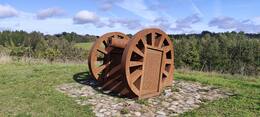
A stylised cannon commemorating the 100th anniversary of the Battle of Giedraičiai
A stylised cannon commemorating the 100th anniversary of the Battle of Giedraičiai is located behind the town of Giedraičiai, 200 m after turning off on road No. 172.
On 21 November 2020, a monument by sculptor Džiugas Jurkūnas was unveiled on a hill at the site of the Battle of Giedraičiai, commemorating the victory. The monument is a stylised interpretation of the battles of the Lithuanian Army against the Polish Army during the inter-war period. In an attempt to move away from the description of the conflict, the monument highlights the importance of the union of the two countries in the context of contemporary events. The rust-covered cannon symbolises the strong union of the re publics of Lithuania and Poland – two countries that fought each other a century before. The situation of the time is described on the sides of the monument; the Lithuanian and Polish Army units involved are mentioned and a brief description of the battle is provided. The Lithuanian Armed Forces are the initiator and the funder of the erection of the monument
Eastern Lithuania (King Mindaugas) region Lithuanian partisan command post
After driving past Andrioniškis Cemetery (there is a signpost), there is a preserved hideout – a command post. From 1944– 1949, a command post of the Lithuanian partisans of the Eastern Lithuania (King Mindaugas) region operated in this hiding place. In the summer of 1944, Balys Žukauskas, with brothers Petras and Juozas Jovaišos, established the hiding place to evade the mobilisation announced by the Red Army in 1944. At the end of 1945, Antanas Slučka-Šarūnas started to use the hiding place. He was the first one to form a partisan unit in the Troškūnai area and later united the partisans of Rokiškis, Anykščiai, Kavarskas, Troškūnai, and Andrioniškis to form the Šarūnas Unit. In 1947, A. SlučkaŠarūnas became the commander of the Algimantas district, and in 1949 – the commander of the Eastern Lithuania partisan region. This means that from 1949, the hiding place became the command post of the Lithuanian partisans in the Eastern Lithuania region. The hiding place, which had successfully sheltered partisans for five years, was betrayed on 28 October 1949. The farm where the partisans were hiding was besieged by KGB troops; the partisans refused to surrender and blew themselves up.
The bunker has been preserved, and a cross and a monument to the fallen have been installed.

Monument dedicated to Algimantas Military District partisans
The monument is located in the centre of Troškūnai, Anykščiai district, near the Church of Holy Trinity. During the partisan war of 1944–1953, the territory of Lithuania was divided into nine partisan military regions. From 1947–1950, partisan units of the Algimantas region of Lithuania, the establishment of which is closely related to Troškūnai, were active in the Panevėžys and Anykščiai area. The inhabitants of this town organised partisan units in Aukštaitija. The first partisan commander of the Algimantas region, Antanas Slučka-Šarūnas, was born and lived in Troškūnai.
In 1996, pursuant to the initiative of the Genocide and Resistance Research Centre of Lithuania, a monument dedicated to the partisans of the Algimantas Military District was erected in Troškūnai. The monument was created by sculptor Jonas Jagėla and architect Audronė Kiaušinienė. The main part of the monument is a black stone gate that symbolises the fallen defenders of the homeland. The bronze crosses on the sides of the gate symbolise the Christian faith, while the bronze sword, like the sword of St Michael the Archangel, symbolises the light of faith and hope. In the square in front of the monument, a black stone plaque commemorates the three units of the Algimantas region: Šarūnas, Žalioji and Kunigaikštis Márgiris.

Exposition on the Resistance to Soviet Occupation and Sąjūdis at the Panevėžys Local Lore Museum
The exposition is located in an authentic place – the premises of the Panevėžys group of the Lithuanian reform movement “Sąjūdis”. The Sąjūdis of Panevėžys has been operating here since October 1988.
In 2004, an exposition on the resistance to the Soviet occupation and an exhibition dedicated to the “Sąjūdis” were opened in the building. The exposition reveals the extent and forms of popular resistance starting from 15 June 1940 to 11 March 1990, and introduces the most importantstages and events of the anti-Soviet movement, as well as Soviet repressions.

Expositions “Okupacijų gniaužtuose” (“In Squeeze of Occupations”) and “Raudonasis teroras” (“Red Terror”) at the Panevėžys Local Lore Museum
The expositions are located in downtown Panevėžys. The Soviets confiscated the house, built at the end of the 19th century for the rominent Moigiai family of Panevėžys. From 1940–1941 it housed the headquarters of the Soviet military unit, the interrogation department of the NKGB (People’s Commissariat for State Security) of Panevėžys District and the militia. From 1944 to 1953 it was the headquarters of the Panevėžys County NKGB-MOI-KGB. It is now the premises of the Panevėžys Local Lore Museum.
The Exposition “Okupacijų gniaužtuose” (“In the Squeeze of Occupations”) presents the Nazi and Soviet occupations. It introduces the themes of the Jewish and Roma genocide, deportations and the themes of partisan war. The part of the exhibition devoted to the years 1953–1990 tells the story of everyday life in Khrushchevka, the efforts of the Soviet government to create a Soviet society, the resistance of people to this violence, and the activities of the underground. You can hear recordings of radio broadcasts from abroad, secretly listened to by the people of the time, with radio interference caused by the Soviet authorities.
The exhibition “Raudonasis teroras” (“Red Terror”) is dedicated to the memory of the victims who were killed in the basement of this house, shot at the Panevėžys sugar factory, as well as the history of the crimes committed by the Soviet occupation regime. The hopes of free people and the destruction thereof under Soviet rule are allegorically depicted in time and space – the interior of the apartment of the merciful Sister Zinaida Kanis-Kanevičienė at the time of the independent Lithuania, who was tortured to death, and a replica of the interrogation room of the NKGB.

“Įstra” Aviation Museum
The museum is located 10 km from Panevėžys, on the left side of the Panevėžys-Pasvalys road (A10; section E67 of Via Baltica) (an informative road sign has been installed).
The museum was established in 2016, inspired by the aviator and aviation enthusiast Virmantas Puidokas, and is located on the grounds of the Įstra airfield. The airfield dates back to 1984 when planes took off from the airfield to spread fertilisers or other chemicals on the agricultural fields. The museum has an open-air and indoor exhibition. The open-air exhibition features Soviet-era Su-15, MiG-21 and MiG-23 fighters, Mi-2 and Mi-8 helicopters, as well as -29 military trainer aircraft built in Czechoslovakia (all aircraft were built in the 1960s and 1970s). Indoor exhibitions introduce the history of aviation in the world and in Lithuania, as well as military aviation equipment, devices and paraphernalia of World War I, World War II and the Cold War. A collection of military pilot equipment, rescue, communication, audio recording and other equipment from different countries is on display, as well as a collection of daggers from the parade uniforms of Air Force officers.

Cross Valley to Commemorate the Baltic Way
The Cross Valley to Commemorate the Baltic Way memorial is located on the eastern outskirts of Pasvalys on the Via Baltica motorway (E67, A10).
On 23 August 1989, to commemorate the occasion of the 50th anniversary of the signing of the criminal Molotov-Ribbentrop Pact and its secret protocol, based on the initiative of the Lithuanian reform movement “Sąjūdis”, the Latvian People’s Front and the Estonian People’s Front, a live human chain linked the capitals of the three Baltic states – Vilnius, Riga and Tallinn. Holding hands, approximately two million people joined together in a living chain that was about 650 km long. This chain, known as the Baltic Way, is one of the most remarkable and memorable events on the road to independence of the countries occupied
by the Soviets.
To commemorate this event, memorial signs have been erected along the Baltic Way route (Vilnius-Ukmergė-Panevėžys- Pasvalys-Saločiai). The Cross Valley to Commemorate the Baltic Way is one of the monuments dedicated to this memorial route. The history of Cross Valley began on the eve of the Baltic Way when the residents of Pasvalys started using boulders to build the Altar of Freedom. On 23 August, the crosses were installed in the valley by the participants of the Baltic Way from Pasvalys, Akmene, Joniškis, Kretinga, Mosėdis, and Pakruojis. Later, crosses were erected to commemorate important events and
people of note, as well as crosses dedicated to the friendly Norwegian and Swedish people.

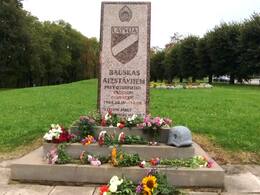
Monument to the defenders of Bauska against the Soviet occupation in 1944 in the Castle Garden
The monument to the defenders of Bauska in 1944 was unveiled on September 14, 2012, at the initiative of former Bauska Volunteer Battalion soldier Imants Zeltiņš and with his and the local government's financial support. The red granite stele, which is mounted on a three-tiered concrete base, is engraved with the text: “To the defenders of Bauska against the second Soviet occupation 1944.28.07.-14.09.” and “Latvia must be a Latvian state. Kārlis Ulmanis.” The unveiling of the monument was followed by protests from the Russian and Belarusian Foreign Ministries and local Russian mass media, but in the spring of 2024 the monument was even attacked by vandals. Despite this, a memorial event dedicated to the defenders of Bauska is held at this location every year on September 14 at 2:00 p.m.
At the end of July 1944, as the Soviet troops approached Bauska, there were no significant German forces in the city, which had recently been deep in the rear. The immediate fall of Bauska was prevented by the decisive action of Major Jānis Uļuks, the head of the Bauska district and commander of the guard regiment, who at the end of July formed the Bauska Volunteer Battalion, which consisted of guards of the 13th Bauska Guard Regiment, police officers, as well as volunteers. The battalion took up defensive positions on the banks of the Lielupe River in Jumpravmuiža opposite the Ziedoņi islet and on the first day it had to engage in battle with the attacking Red Army. Initially, the battalion was very poorly armed, and most of its automatic weapons had to be obtained as trophies. A few days later, the 23rd, 319th-F. and 322nd-F. Latvian police battalions also joined the war effort. Until mid-August, the 15th Latvian SS Reserve and Supplement Brigade Battalion, formed from training and medical companies, also participated in the defense of Bauska against the second Soviet occupation. In total, 3,000-4,000 Latvian soldiers participated in the battles for Bauska, who at the end of the battles had to face a tenfold superiority. Soviet troops managed to take Bauska only on September 14, after a month and a half of resistance by Latvian and German soldiers.
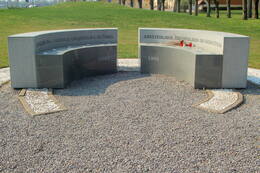
Мемориальный ансамбль в память о борцах с советской оккупацией и жертвах коммунистических репрессий в саду Бауского замка
Мемориальный ансамбль в саду Бауского замка был открыт в 90-ю годовщину Латвийской Республики – 18 ноября 2008 года. Мемориал создан по идее клуба политических репрессированных Бауского края «Рета». Двухчастный памятник из серого гранита изготовлен по проекту архитектора Инты Ванаги на средства Бауского городского самоуправления и спонсоров. На нём выгравирован текст: «Борцам с советским оккупационным режимом, арестованным, депортированным и замученным в 1940–1990 годах». Ежегодно 25 марта и 14 июня здесь проходят памятные мероприятия, посвящённые жертвам депортаций 1941 и 1949 годов.
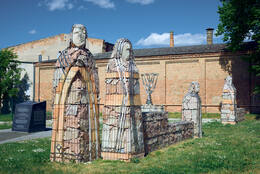
Мемориал «Сад Синагоги»
Мемориал расположен в центре города, недалеко от туристического информационного центра Бауского края и Ратушной площади.
Он был создан благодаря инициативе и пожертвованиям потомков бауских евреев, проживающих в Израиле, США и Великобритании, а также поддержке Бауской городской думы и еврейских общин Латвии.
Мемориал был спроектирован скульптором Гиртсом Бурвисом. Он такого же размера, как и бывшая Большая Бауская синагога, а каменные изваяния символизируют евреев, выходящих из молитвенного дома после службы. В центре мемориала расположена символическая бима – возвышение или стол, используемый в еврейских религиозных ритуалах в синагоге. Надпись на нём гласит: «Посвящение евреям Бауски, которые веками жили здесь и строили этот город, и которые были убиты нацистами и их местными пособниками в 1941 году. В память о еврейском народе – потомках евреев Бауски и жителей Бауски».
В 1935 году в Бауске проживало почти 800 евреев. После нацистской оккупации, в июле 1941 года, многие евреи были арестованы и депортированы, около 700 евреев были расстреляны. Большая Бауская синагога была разрушена во время Второй мировой войны.
Памятник Свободы в Иецаве
Памятник Свободы в Иецаве, высеченный в камне Петерисом Бандерсом в 1936 году, расположен в Иецавском парке на берегу долины реки Иецава.
Идея создания памятника принадлежит Янису Лусису, настоятелю прихода Иецава-Ламбарте, участнику Войны за независимость Латвии. Памятник посвящён воинам 4-го Валмиерского пехотного полка, павшим в окрестностях Иецавы, и латышским воинам, отдавшим свои жизни в Войне за независимость Латвии. Во время советской оккупации памятник был взорван, однако не уничтожен и восстановлен в 1988 году. В 2018 году памятник был включён в список памятников культуры, охраняемых государством.
11 ноября 2018 года в Иецавском парке была открыта памятная доска пяти кавалерам ордена Лачплесиса, родившимся в бывшем Иецавском крае. Награждены генерал Вернерс Тепферс, подполковник Екабс Юршевскис, капитаны Николай Плявниекс и Гербертс Тепферс, а также капрал Екабс Клаусс. Гранитная статуя была создана в рамках проекта «Aceries Lāčplēšus» («Помни медвежонков») в память о солдатах, павших в Освободительной войне Латвии.

Памятный знак, посвященный 25-летию Балтийского пути
Во время акции «Балтийский путь» 23 августа 1989 года на участок шоссе Рига – Бауска прибыли жители Курземе и Земгале – Лиепаи, Салдуса, Добеле, Кулдиги, Вентспилса, Талси, Тукумса и их окрестностей. Главной задачей было добиться максимально равномерного распределения людей и непрерывности цепи. Там, где не хватало длины рук, предлагалось использовать флаги, пояса или даже рукава курток, чтобы не прерывать кровообращение общества в этой артерии. Всего в акции приняли участие около 400 000 жителей Латвии.
Памятный знак, посвященный 25-летию Балтийского пути, был открыт 23 августа 2014 года в Кекавском крае, на 25-м километре шоссе Рига-Баускас, у реки Кекавиня. В торжественной церемонии открытия приняли участие премьер-министр Латвийской Республики Лаймдота Страуюма, многолетний сотрудник ГАО «Latvijas Valsts ceļi» и участник Балтийского пути Улдис Бирзлея, а также другие гости. В 2014 году в память об этом событии на участке Балтийского пути в Латвии было установлено 10 таких памятных знаков. Четыре памятных знака установлены в Эстонии и девять в Литве. 30 июля 2009 года акция «Балтийский путь» была включена в список документального наследия ЮНЕСКО «Память мира».