



The military heritage of Tartu and the surrounding area on land and in the sky
Day 1.
25 km
Tartu–Lange
Practical info
Excursions and educational programs must be booked in advance and reserved for a specific time. You should not choose to include more than two museums and 2-3 monuments or sights on your itinerary during one trip.
- Start : Tartu.
- Finish : Long.
- Duration : 6-8 hours
- Additional options : Museum lessons can be ordered at the KGB Camera Museum: “Class Excursion” , “Armed Resistance – Forest Brothers in Estonia” , “Deportations” , “Propaganda” and “Tartu in the Second World War” for older elementary school classes and secondary schools. An audio guide is available at the Estonian Aviation Museum, which introduces the museum’s exposition.
Sights
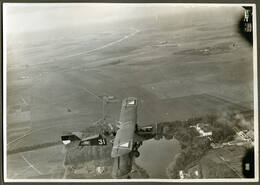
Raadi Military Airfield
This airfield is a former air base on the north-eastern outskirts of Tartu.
On 14 April 1912 Russian pilot Sergei Utochkin made history by completing the first motorised flight in Estonia, in a Farman biplane above Raadi Manor. Baron Liphart, the lord of the manor, had his farmland converted into a runway in summer 1914. During the interwar period of Estonian independence, the 2nd Squadron of the Aviation Regiment was stationed in Raadi. During the 1950s and 1960s the airfield was refashioned into one of the largest air bases in Eastern Europe, at which strategic long-range bombers were stationed. The last landing in Raadi is believed to have taken place in 1996. Plans for renovating the airfield were abandoned in 1999. The airfield has since been decommissioned.
It is situated next to Raadi Manor. In 1922 the Estonian National Museum was established in the manor, which had been expropriated from the Lipharts in 1919. Aerial bombings in August 1944 set fire to the manor, and it burnt down. In 2016 the new building of the Estonian National Museum was opened in Raadi, located at the end of a former runway. The building, which is 350 metres long and rises from the ground, gives the impression of being an extension of the runway.
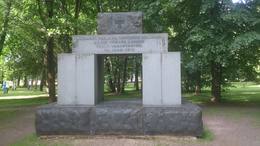
Monument to the Liberators of Southern Estonia and Raadi Military Cemetery
This monument is situated on the Nurme Street side of Raadi Cemetery in Tartu.
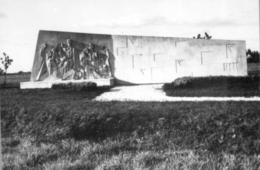
The monument, which was situated in the cemetery of the Tartu Garrison, was proposed by two-time recipient of the Cross of Liberty Colonel Siegfried Pinding. Each side of the monument represented one of the southern counties of Estonia, with the five smaller pillars representing the towns of Tartu, Valga, Viljandi, Võru and Petseri. Fashioned by Anton Sobolev and Voldemar Mellik but left unfinished due to a lack of funds, it was unveiled on 17 October 1926. After World War II the monument was destroyed and its pieces buried. The original pieces were dug up in 1988 and used to restore the monument, which was unveiled anew on 10 July 1991 near its original site – still unfinished.
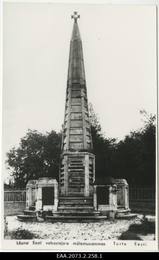
Monument to the Battle of Tähtvere
This monument, designed by Aleksander Eller and commemorating the Estonian victory over the Red Army Latvian Riflemen in the Battle of Tähtvere on 14 January 1919, was unveiled on 3 July 1932. It was demolished in 1940, but restored in 1942. After the war, the Soviet regime had the monument completely destroyed and eventually replaced, in 1957, with a bust of Hans Heidemann, a figure in the workers' and trade union movement. Restoration of the monument was proposed by Enn Tarto, and it was unveiled anew at its original site on 2 July 2006.
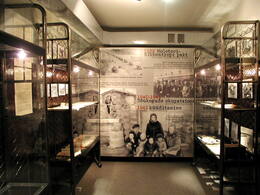
KGB Cells Museum
This museum is situated on the corner of Riia and Pepleri streets in Tartu.
It is a branch of Tartu City Museum. The museum is located in the infamous grey building on Riiamägi Hill that the KGB used as their base of operations in Tartu during the 1940s and 1950s. The basement here was used as a pre-trial detention centre for political detainees. Now, many years later, it is open to visitors. Some of the cells (including those used for solitary confinement) and part of the corridor have been restored to their original appearance. The exhibition in its former jail cells provides an overview of World War II, the post-war anti-Soviet resistance in Estonia, the crimes committed by the communist regime and the conditions in the detention centre. The idea of opening the museum came from members of a former underground student resistance group in Tartu called Blue-Black-White, who discovered upon visiting their former cells that the basement had been abandoned and that it would not be very difficult to restore the former look of the jail. The museum was officially opened on 12 October 2001.
Tartu Anti-Tank Line – Jalaka Line
The Jalaka Line (named after the Chairman of the Executive Committee of Tartu, Kristjan Jalak) was an anti-tank trench dug alongside the Riga road near the village of Räni four kilometres outside of Tartu in summer 1941 as a countermeasure against the German offensive.
Part of the line is situated in Lemmatsi, another village outside of Tartu by the E264 towards Valga. The other part was established on the right bank of the Emajõgi River stretching from Kärevere to Praaga.
Citizens of Tartu aged 16-55, men and women alike, were forced by the Soviet regime to construct the fortifications for the Jalaka Line. The German regime used the trenches in 1941 and 1942 to execute those in its Tartu concentration camp who had been sentenced to death. During the Soviet era a monument was erected, designed by Elmar Rebase and Väino Tamm, in memory of the victims of terror.
Estonian Aviation Museum
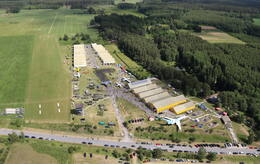
The museum is situated in the village of Lange and covers 10 hectares. It was officially opened in 2002. Its goal is to preserve aviation history related to Estonia and to showcase and promote aviation. Its main partners are the Estonian Aviation Academy, the Estonian Air Force, the Border Guard Aviation Group and the Estonian War Museum. The exhibition displays five helicopters and 33 planes, including anti-aircraft missiles. Most of these rare exhibits date from the Cold War era. The museum has a fine collection of aircraft and missiles, with over 600 exhibits. The Aviation Museum holds an annual aviation-themed event on the second weekend in June.
Monument to the Battle of Reola
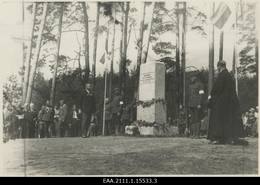
This monument is situated in the village of Tõõraste in Kastre municipality. Designed by Anton Sobolev, it commemorates the Battle of Reola, which was one of the turning points in the War of Independence. During the battle, which took place on 16 & 17 January 1919, the Estonian forces thwarted the Red Army’s attempt to capture Tartu. The monument was unveiled on 3 July 1932. After World War II it was knocked down and buried. On 27 November 1988, the monument, now dug up and restored by the Kambja Heritage Association, was unveiled anew.
Places to eat
- Gunpowder Cellar https://pyss.ee/
- Bad Boys https://pahadpoisid.ee/
- University Cafe https://kohvik.ut.ee/
- https://visittartu.com/