


The end of World War II and the beginning of the Soviet occupation of Courland and Samogitia
Ezere local history repository “Muitas Nams” (Customs House)
The Ezere Customs House is located in Ezere near the Saldus-Mažeikiai highway at the Latvian-Lithuanian border. The act of surrender of the German Army units ‘Kurzeme’ (Kurland) surrounded in the so-called ‘Courland Pocket’ was signed in this building on 8 May 1945. It is believed that World War II actually ended in Ezere. The customs house has an exhibit covering the events of the end of World War II and exhibits detailing the history of Ezere parish from ancient to modern days. In the morning of 7 May 1945, the commander of the Leningrad Front, Marshal L. Govorov, sent an ultimatum to the command of the army group ‘Kurzeme’ to lay down arms. The act of surrender was signed by the involved parties on May 8 and it detailed the procedure of surrender, weapons collection points, documents and information to be submitted and other practical measures.
Plokštinė Military Town
In 1962, one of the first underground launch complexes for R-12 ballistic missiles in the Soviet Union, the Dvina, was put into operation in Plokštinė Forest (Plungė district).
A military camp was set up 0.5 km from the missile launch site. It occupied an area of 12 hectares, and approximately 30 buildings were built here for various purposes, including residential houses (barracks), officers’ headquarters, two canteens, a boiler house, a power station, a medical post, a club, a pig farm, warehouses, garages, and other structures.
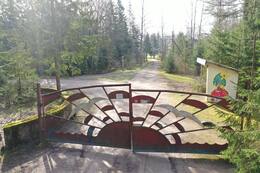
The Plokštinė underground missile launching complex was operational until 18 June 1978. The Soviet soldiers left the area, taking only their weapons with them. In 1979, the management of the former military complex was transferred to the Republican Association of Agricultural Recreation Facilities of Plungė District, and the Plateliai Pioneer Recreation Camp “Žuvėdra” was established at the military campus site. The site was reconstructed and adapted to the needs of the camp, which operated until 1990. After the restoration of Lithuanian independence, the Pioneer Camp was closed.
Since 1993, the site has been managed by the Žemaitija National Park Directorate. In 2017, many of the structures on the military campus were demolished due to their state of disrepair. Today, there are about ten buildings left at the site, and visitors may see them from the outside. Information boards about the former buildings and their functions have been installed.
Samogitian Museum "Alka"
The museum is located in Telšiai, on the north-western shore of Lake Mastis. In 2024, the Samogitian Museum “Alka” opened its doors after reconstruction. The museum presents the history and culture of Žemaitija region – archaeological finds, rare and interesting historical objects, a collection of ethnographic treasures, works of inter-war and diaspora artists, as well as the heritage of the outstanding estates of Žemaitija. The museum also attracts visitors in terms of its collection of military heritage, with three interesting exhibitions dedicated to it.
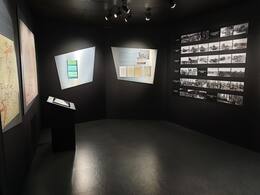
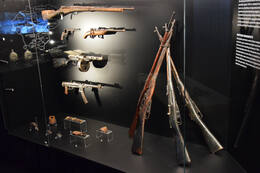
One of them is the audiovisual installation “The Fracture of Eras”, which is supplemented by a small exhibition of World War II artefacts. A special exhibition is divided into two parts – the Nazi German occupation and the Soviet occupation, which features authentic objects used by soldiers and video projections. In the “Lost Stories” part of the exhibition, the stories of different people and families reveal the period in the history of the nation, during which the terror of the Soviet occupation regime reigned against the local population. The exhibition “Partisan War in Žemaitija” is stylised, demonstrating the interior of a partisan hideout. The exhibition provides an insight into the structure of the Lithuanian partisans and displays authentic historical objects and samples of weapons, a fragment of a documentary film, and photographs of the partisans.
Cold War exposition
On 31 December 1962, one of the first underground launch complexes for R-12 ballistic missiles in the Soviet Union, the Dvina underground launch complex, was put into operation
in Plokštinė Forest (Plungė district).
Between 1963 and 1978, four R12 medium-range ballistic missiles (SS-4 Sandal) equipped with a 2.3-megatonne nuclear warhead were deployed at the complex. All the missiles were aimed at Western European countries. This complex, together with similar surface-launched missile bases, formed a single Soviet nuclear arsenal in Lithuania, which was capable of destroying the whole of Europe. In its 16 years of operation, not a single missile was fired, despite the declaration of combat readiness during the Prague Spring in 1968.
After the Soviet soldiers left on 18 June 1978, the poorly guarded military facility was vandalised and looted. In 1993, when the complex was handed over to the Žemaitija National Park Directorate, its restoration began. In 2012, the Cold War exposition was opened. Today, this once very secret and guarded place is open to the public. A historical exposition on the Cold War period is on display at the former missile and equipment control room house. To date, it is the only museum in Europe where a preserved underground missile launch silo is on display.
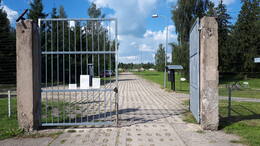
Saldus German Soldiers' Cemetery
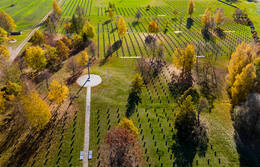
The Saldus German Soldiers' Cemetery is located on the Saldus–Ezeres highway. The cemetery, which covers an area of 8 hectares, contains the remains of around 25,000 German soldiers, as well as some Latvian legionnaires. Reburials have been taking place since 1997.
From May 1 to October 1, an exhibition about the battles of Courland can be viewed in the memorial room. During this period, the memorial room is open on weekdays from 9:00 to 17:00, and on Saturdays and Sundays a guide is also working in the cemetery. Registers of soldiers buried in the Saldus German soldiers' cemetery and soldiers who fell throughout Latvia are also available.