


The Cold War in the Platelia Lake area, Samogitia National Park
Plokštinė Military Town
In 1962, one of the first underground launch complexes for R-12 ballistic missiles in the Soviet Union, the Dvina, was put into operation in Plokštinė Forest (Plungė district).
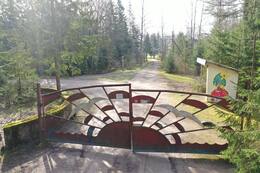
A military camp was set up 0.5 km from the missile launch site. It occupied an area of 12 hectares, and approximately 30 buildings were built here for various purposes, including residential houses (barracks), officers’ headquarters, two canteens, a boiler house, a power station, a medical post, a club, a pig farm, warehouses, garages, and other structures.
The Plokštinė underground missile launching complex was operational until 18 June 1978. The Soviet soldiers left the area, taking only their weapons with them. In 1979, the management of the former military complex was transferred to the Republican Association of Agricultural Recreation Facilities of Plungė District, and the Plateliai Pioneer Recreation Camp “Žuvėdra” was established at the military campus site. The site was reconstructed and adapted to the needs of the camp, which operated until 1990. After the restoration of Lithuanian independence, the Pioneer Camp was closed.
Since 1993, the site has been managed by the Žemaitija National Park Directorate. In 2017, many of the structures on the military campus were demolished due to their state of disrepair. Today, there are about ten buildings left at the site, and visitors may see them from the outside. Information boards about the former buildings and their functions have been installed.
Cold War exposition
On 31 December 1962, one of the first underground launch complexes for R-12 ballistic missiles in the Soviet Union, the Dvina underground launch complex, was put into operation
in Plokštinė Forest (Plungė district).
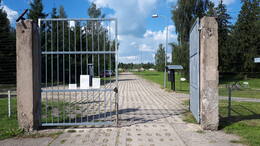
Between 1963 and 1978, four R12 medium-range ballistic missiles (SS-4 Sandal) equipped with a 2.3-megatonne nuclear warhead were deployed at the complex. All the missiles were aimed at Western European countries. This complex, together with similar surface-launched missile bases, formed a single Soviet nuclear arsenal in Lithuania, which was capable of destroying the whole of Europe. In its 16 years of operation, not a single missile was fired, despite the declaration of combat readiness during the Prague Spring in 1968.
After the Soviet soldiers left on 18 June 1978, the poorly guarded military facility was vandalised and looted. In 1993, when the complex was handed over to the Žemaitija National Park Directorate, its restoration began. In 2012, the Cold War exposition was opened. Today, this once very secret and guarded place is open to the public. A historical exposition on the Cold War period is on display at the former missile and equipment control room house. To date, it is the only museum in Europe where a preserved underground missile launch silo is on display.
Monument to the Defenders of Lithuanian Freedom (Plateliai)
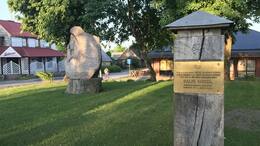
The monument to the Lithuanian Freedom Army (LLA) stands near the square of the town of Plateliai. It commemorates the resistance of the Lithuanian people, which began in July 1944, when the Soviet army entered Lithuania for the second time. During the active resistance, LLA soldiers gathered in the Plateliai forests in Samogitia on August 15 and established the Hawks organization.
The LLA was founded in December 1941 in Vilnius by Kazys Veverskis. It was a secret Lithuanian national-political organization whose goal was to fight for the independence of Lithuania, using not only diplomatic and political, but also military means. The ranks of the LLA included soldiers, riflemen, students, and ordinary Lithuanians who actively resisted the occupation.
In August 2004, to commemorate the 60th anniversary of the Vanagai military training camp in the Plateliai forests, the first monument to the Lithuanian Freedom Army in Lithuania was unveiled in the town at the initiative of Vytautas Urbikas and Albinas Klimas. Its author, the Samogitian sculptor Antanas Vaškys, created a monument made of field stone, 2.25 m high and 1.1 m wide, and carved the image of the warrior and the inscription: “Lithuanian Freedom Army 1941–1944–1953. Lithuanians’ fight for freedom is eternal.” The sculptor ensured that this monument would stand for as long as 500 years.
Litvak Memorial Garden
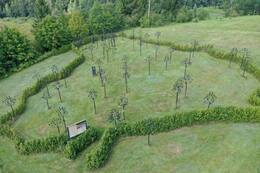
In 2014, the Jacob Bunka Charity and Support Foundation established the Litvak (Lithuanian Jew) Memorial Garden in Žemaitija National Park, approximately two kilometres from the centre of Plateliai, in the village of Medsėdžiai. It is a monument dedicated to the eliminated Jewish communities of Lithuania. The garden reproduces the contours of Lithuania, while the sites where Jewish communities were eliminated in 1941–1944 are marked with wrought-iron apple trees. The author of the carved apple trees is Artūras Platakis. The apples in the trees signify families that have lived in these communities. Litvaks from around the globe can participate in the development of the garden by ordering new apple trees and apples in memory of their ancestors. The garden also features pillars made of Karelian granite that individually celebrate the achievements of Litvaks worldwide.
In 2016, the initiative was extended to include the Litvaks, who lived throughout the territory of the Grand Duchy of Lithuania, and the rescuers of Jews during the Holocaust. A billboard at the entrance to the garden tells the story of former Jewish communities throughout Lithuania.
Currently, apple trees to commemorate the Jewish communities of Alytus, Alsėdžiai, Kalvarija, Mosėdis, Plateliai, Plungė, Telšiai, Vabalninkas, Viekšniai, and others have “grown” at the garden.