


“Iron Curtain” on the Lithuanian coast
World War II Exposition “Muziejus 39/45”
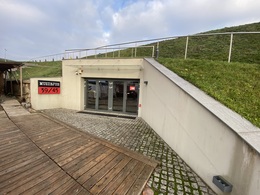
“Muziejus 39/45”, which belongs to the History Museum of Lithuania Minor, tells the story of the Second World War events in Klaipėda and the region. The museum is located under a rampart on the eastern side of the former Klaipėda Castle, where German troops had set up an explosives depot during the war.
The exposition of the museum is modern and engaging for visitors: the exposition consists of four halls that present different periods of the wartime, and 13 interactive points have been installed in the halls. The hall “Klaipėda on the Eve of War” displays historical documents and photos, while the radical changes in Europe of the time are described on an original animated map. The hall “The Storming of Klaipėda” reflects the very tragic history of Klaipėda and its inhabitants, while the second hall “Klaipėda after the War” features an installation commemorating the demolished churches of the city. The last one – the Hall of Memories – features a symbolic six-metre-long carriage with a glass roof, under which multiple simple household objects that once belonged to both German soldiers and Klaipėda civilians are on display. The glass is coated with a layer of sand, so you have to brush the sand off with your fingers to see the exhibits.
Mine countermeasures ship-museum M52 "Sūduvis"
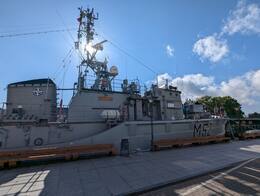
The M52 “Sūduvis” mine countermeasures ship-museum is located on the Karališkoji Danės waterfront of Klaipėda, next to Castle Bridge.
It is a “Lindau” mine trawler class ship, built in 1956–1958 in West Germany. The mission of these ships is to detect and destroy sea mines. The hull was therefore made of Brazilian oak, the deck of teak, and the machinery, of non-magnetic metal.
From 1958 to 1999, the ship belonged to the German Navy and was named M1071 “Koblenz”. From 1978–1979, it was converted from a mine trawler to a mine hunter.
In 1999, the ship was transferred to the Lithuanian Navy. Navy ships are traditionally named after historical regions of Lithuania, so the received ship was also named M52 “Sūduvis”. The ship served Lithuania for 22 years, taking part in international and national exercises and operations. In 2021, the ship left the service of the Lithuanian Navy and was handed over to the Lithuanian Maritime Museum. Then, 52 “Sūduvis” was opened to the public and adapted for the needs of museum and educational use. The vessel on display has authentic operational equipment.
“Memel-Nord” Coastal Artillery Battery
The “Memel-Nord” Coastal Artillery Battery is located in Giruliai, next to the “Olando kepurė” (Dutch hat) on the Baltic Sea coast.
The “Memel-Nord” Coastal Artillery Battery is a part of the coastal defence system of the German Navy, built in 1939 after the annexation of the Klaipėda region to Germany and the beginning of the fortification works of the city. “Memel-Nord” is an integral part of the fortifications of Klaipėda fortifications, consisting of two coastal artillery and six air defence batteries.
The fortifications of the coastal artillery battery were built in two phases: In April and May 1939, temporary fortifications were built for the coastal artillery battery, and at the end of 1939, a decision was made to extend them by developing a permanent position. For this purpose, the coastal artillery battery was equipped with four gun emplacements, equipped with 150 mm SKL-45 guns, fire control posts and an ammunition depot for 150 artillery shells. After the completion of the works, the battery was named “Brommy”.
The battery consists of three structures, with a concrete fire control point in the centre and two artillery blocks with ammunition depots next to it. Since 2002, an exhibition on the history of the Klaipėda region has been opened in one of the artillery blocks.

Museum of Exile and Resistance in Palanga
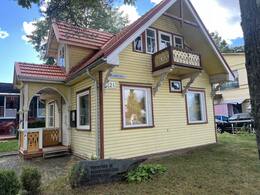
The museum is located in downtown Palanga, in one of the smallest wooden villas of the Palanga resort – Vaidilutė. It was established in 1993, based on the initiative of the Palanga branch of the Lithuanian Union of Political Prisoners and Deportees. The department continues to look after the museum today on a community basis. The volunteers have adapted the villa to the specific needs of the museum and lead the tours themselves.
The exhibition tells the story of the participation of Lithuanians in the resistance movement and the deportations that destroyed people’s lives.