


“On the Tracks of History” – Haapsalu and Lääne County
Memorial to People Deported from Western Estonia
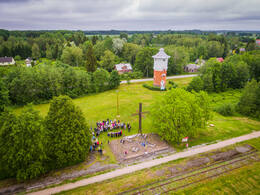
This monument is situated in the small borough of Risti, next to its railway station.
Designed by Viljar Ansko, the monument was unveiled in 1999 and is dedicated to all of those deported from Western Estonia.
Risti station, the last stop in Lääne County, was the point from which not only the majority of the people from the local area, but also those from Pärnu and Rapla counties and the islands of Hiiumaa and Vormsi were deported to Siberia. A total of 3000 deportees passed through here along with people arrested in Lääne County. The 13-metre monument is mounted on a small railway platform with stone stairs at both ends. Four rails rise up into the air from the platform, which are bound together by a double cross made from rails. Aside from commemorating the mass oppression of the recent past, the cross also represents the history of Risti as a railway settlement.
Monument to the War of Independence in Haapsalu
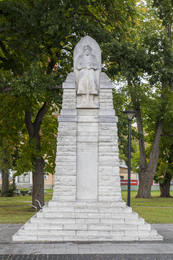
This monument, designed by sculptor Voldemar Mellik, was unveiled on 1 November 1924. The cost of the monument came to 746,000 marks, which was no small sum. It was in part funded by donations, with Mellik pushing back the deadline for them to be made a number of times. A memorial to the fallen from Lääne County, it is an obelisk made from dolomite ashlar in rustic style which supports a relief depicting a soldier standing at attention. It was demolished on 19 June 1941 under the supervision of the chairman of the local executive committee Evald Kaar. After its demolition, the site became a flowerbed with blue, dark blue and white flowers (recalling the colours of the Estonian flag), which were quickly ripped out. In winter 1942 a monument carved from ice was installed here. The monument was unveiled anew on 27 November 1994. Fully restored, it was fashioned by sculptor Vambola Mets and again funded by donations from the kind people of Haapsalu.
Railway and Communications Museum in Haapsalu
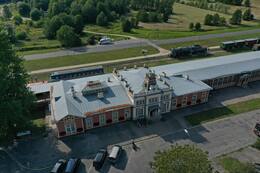
This museum is housed in a train station built in the early 20th century to service the railway line connecting to the resort in Haapsalu.
Opened in 1997, the museum showcases the one-and-a-half centuries of development of Estonian railways and mediums of communication. Besides decommissioned locomotives, the museum displays an affable station master and an Ericsson Skeleton Type telephone and invites visitors to the station's post office.
The outdoor exhibition also displays a World War II steam locomotive 52 3368.
The steam locomotive 52 3368, initially numbered 16494, was completed in April 1943 in Munich at the Krauss-Maffei Works and then transported to Austria, the Bruck an der Mur depot of the Villach division. The Hungarian State Railways (MAV) rented the locomotive and on June 7, 1945, it was captured by the Red Army. When the Hungarian-Romanian border was altered, locomotive 52 3368 was given to the Romanian railway (CFR). In August 1950, at the CFR Iași Works the locomotive was converted to broad gauge (5 ft) and given to the Soviet Union, where it operated at the Kotovsk and Vapnyarka depot of the Odessa Railway from October 1950 to 1956. After that, the Ministry of Transportation of the USSR kept it in the strategic reserve. On August 26, 1957, the locomotive TE-3368 (ТЭ-3368, the class 52 was renamed as TE in 1952) arrived at the Valga locomotive base. There the loco got another tender (so-called Wannentender), built in 1943 by Borsig Works in Berlin and formerly belonging to locomotive TE-450. It could carry 32 m3 of water and 10 tonnes of fuel. The locomotive stayed in Valga (from 1961 to 1968 shortly in Tartu) until the base was closed in 1997. From 1950 to 1985, its kilometrage as a broad-gauge locomotive was 463,216 kms. On May 8, 1998, the steam locomotive was delivered to Haapsalu to be exhibited at the Railway Museum.
The class 52 war locomotive was designed in a hurry in June 1942 on request of the Reich´s Ministry of Armaments and War Production in the example of the class 50 locomotive. The 2-10-0 type engine had a power of about 1,500 hp and a maximum speed of 80 km/h. It had a simplified and light design (15-ton axle load) with an intended life-span of 5 years. From 1942 to 1945, a total of 6,295 locomotives of that class were built in 14 factories across Europe. After World War II, the class 52 locomotives had spread all over Europe, from Norway to Turkey and from Belgium to the Soviet Union. There were over 2,000 locomotives in the USSR – the exact number remains unknown, as the locomotives were subject to different authorities, including security authorities. In Estonia, the class 52 steam locomotives ran first on standard-gauge (1,435 mm) lines in 1943–44. Since 1953, when they replaced the American class ShA war locomotives (the Shariks) in Estonian freight traffic, 138 class TE (52) regauged locos have been here. By 1991, only one remained in Estonia – the TE-3368.
Monument to the War of Independence in Nigula
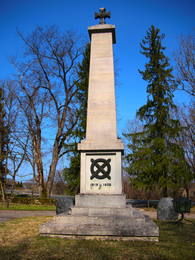
Situated in the village of Nigula in Lääne-Nigula municipality, this monument, designed by Roman Espenberg (Haavamägi), was unveiled on 14 September 1930. The obelisk stands on a plinth with a stepped footing, topped by a step pyramid and crowned with a bronze Cross of Liberty. The front of the plinth is adorned with a bronze low-relief depicting a soldier caring for his wounded comrade. It was demolished in 1946, but the foundations and bronze details survived. The monument was unveiled anew on 10 September 1989. Its dolomite parts are exact copies of the original, while the bronze parts were restored. The names of 19 people killed in the War of Independence and 61 in World War I are inscribed on the monument. In addition, there is a memorial to those killed in World War II and to those deported next to the monument.