


Military heritage of Saaremaa
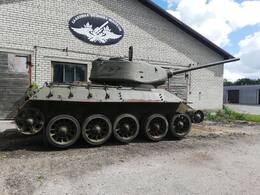
Military Equipment Museum of Saaremaa
The Military Equipment Museum on Saaremaa was established in 2007. Its collection comprises the private items (approximately 12,000 of them) of its founding members.
The museum organises themed hikes and re-enactments of historical battles showcasing the military history of the 20th century. Covering 650 m2, the museum comprises five exhibition halls open to visitors, including an outdoor exhibition (of larger military equipment). The centrepiece of the War of Independence Hall is the machine gun wagon of the 3rd Armoured Train. The exhibition displays original uniforms, weapons and other personal equipment from the War of Independence (1918-1920). The Hall of Historical Uniforms displays the original uniforms of the Estonian Defence Forces and Defence League from the interwar era (1925-1940) and original uniforms from World War II, along with other equipment. The Hall of Weapons displays European firearms and sidearms from 1450-1970. The Hall of World War II Personal Equipment and Kitchenware provides an overview of soldiers' everyday items. The Hall of Technical Equipment displays communication devices, cannons, mortars, bicycles, motorcycles and cars.
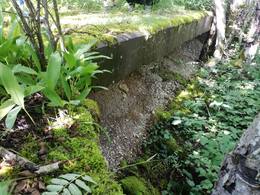
Võiküla 36th 10-inch Coastal Defence Battery and cobbled road
This coastal defence battery is situated between the villages of Võiküla and Rässa. The 36th 10-inch Coastal Defence Battery formed part of the 1st Battalion of the Muhu Strait fortifications during World War I. Its construction began in 1915. The battery comprised five 10-inch (254-mm) Durlacher-type guns, which were mounted on wooden barbettes later upgraded to concrete emplacements standing 70 metres apart. The artillery was protected from the front by a 400-metre-long sand wall piled without the use of machinery, 15 metres wide at its ridge and 25 metres wide at its foot.. The battery was active in combat during Operation Albion, the German offensive in 1917.
It is in good condition, considering its exposure to the elements, but all of the gun emplacements and the cemented front wall are partially overgrown. The cobbled road is in good condition.
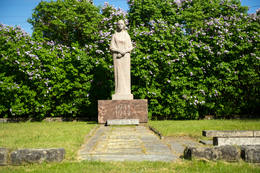
Mass grave of those who fell in World War II and Monument of the Grieving Mother
This monument is situated at the tip of Väike Strait on Muhu, near the old road.
The mass grave was marked with a statue of the Grieving Mother, a grandiose granite monument eloquent in its simplicity which was unveiled in 1972. The sculpture surmounts a polished granite plinth. The grave is surrounded by a low dolomite fence.
The monument is made from red granite, while the statue is carved and the plinth is polished. It depicts a mourning woman standing with her arms crossed. The statue stands 2.5 metres high and its base dimensions are 1.6 x 0.78 x 0.75 metres. The base is engraved with the years 1941/1944. The engraving is 18 cm in height.
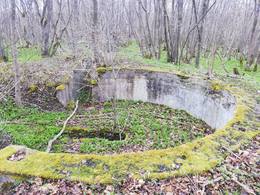
Kübassaare 130-mm Coastal Defence Battery
This 130-mm battery is situated at the tip of Kübassaare Peninsula.
Unfinished, it comprised four 130-mm 50-calibre B13 Pattern guns with a range of 24 km and a sector of fire of 166°. The crew was meant to consist of 160 men (nine Soviet officers, 39 non-commissioned officers and 112 Red Fleet marines), but historical records state that as at 1 February 1941 there were five officers, 23 non-commissioned officers and 135 Red Fleet marines here.
As the complex was not finished on time, only the concrete emplacements of the naval guns and the incomplete bunkers remain today.