


Military heritage of Hiiumaa Island
The wreck of the ship "Alar"
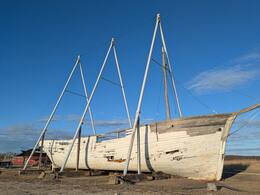
The ship "Alar", also known as "Ernst Jaakson", is one of the most remarkable historical ships in Estonia. The 35-meter-long and 8-meter-wide three-masted motor sailboat was built from 1937 to 1939 in the village of Õngu on the island of Hiiumaa, under the leadership of local residents and master craftsman Peeter Himmi. It is the largest wooden ship of its type that has survived in Estonia.
The ship's first captain was Arnold Tõri, whose father was one of the ship's owners. Initially, "Alar" was used to transport timber, but in 1940 it began transporting building materials to Soviet army bases. During World War II, the ship remained in Estonian waters. At the end of the war, the owners and crew planned an escape to Sweden, but the plan was discovered and they were arrested. The ship's command was imprisoned in Tallinn, but the Germans took over the ship and renamed it "Kurland", taking it to Germany.
After the war, Arnold Thiri, who had moved to the United States, found the ship in Hamburg, brought it to England, where it was rebuilt and renamed "Arne". The ship later sailed under the Swedish flag until 1968, when it was bought back and taken to Denmark for restoration.
In 1998, after almost 60 years, the ship was brought back to Hiiumaa Island and moored at Sõru Harbour, the only wooden boat and ship restoration center in Estonia. In the same year, the ship was renamed "Ernst Jaakson", in honor of the long-time Estonian diplomat who represented the country's continuity in the United States during the time when Estonia was part of the USSR.
Currently, "Alar" is located in the port of Sõru, in the village of Pärna, on the island of Hiiumaa and is freely accessible at any time.
130-mm Coastal Battery No 44 at Tohvri (Hindu)
A building battalion of the Red Army arrived in Hindu village in October 1939. The local population was ordered to leave their homes before winter. By the following spring the battery area was surrounded by a wire fence. Building material arrived via Sõru Port where work was done in 3 shifts, 24 hours a day. At least a hundred local men were employed to build the battery. Concrete mix was manually made in large tubs, foundation holes were dug. The barracks were going to have two storeys, the second storey angle iron framework was completed when the top committee came to check on the construction. An order was given to demolish the second floor because it was visible from the sea. By the autumn of 1940 two barracks, two officers’ residential buildings, a canteen, two saunas, a food cellar, two firefighting water reservoirs and a gate guard post were completed. A large-scale construction was to continue and there were a couple of thousands of tons of cement in the depots.
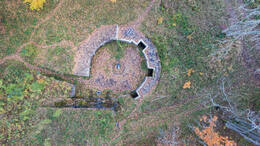
The crew of the battery included 5 officers and 125 lower rank soldiers. The test firing of guns took place in summer 1941 when boat-like vessels with masts towed by tugboats on long wire ropes appeared. The battery was never fully completed, some of the shelters and the water reservoir are not covered with earth. The armoured doors were probably never fully installed. Just the concrete floor of the gas shelter (shelter-power station) with its spiky reinforcement iron bars got completed. One gun and its crew were taken to Heltermaa in September 1941. During the German landing in October an ammunition shelter together with the rest of the battery’s ammunition were blown up. The powerful explosion ripped and scattered the walls of the explosive charge room and raised its roof into the air which broke in two after falling on the standing wall.
The other three gun blocks have survived more or less intact and dry. Recently, the area has been cleared and the positions can be fairly easily identified. The command post is half filled with water the whole year round. Due to its wet location the ferroconcrete and bricks are in a notably worse condition than in Tahkuna.
Around the battery there are five machine gun bunkers, each of a different construction. A couple of hundred metres to the Northwest of the battery position there is a small open observation post. There are two machine gun bunkers by the base as well. Near the upper lighthouse of Sõru there are the ruins of a machine gun bunker with a shooting sector of laid bricks. At least 15 such weapon pits were built between Tärkma and Õngu in 1941.
In 1944–1945 the battery was reconstructed with three 130-mm guns. The last training shots were taken on 23.09.1957. The following March the guns were taken away and then the battery was closed down. Today the former base accommodates Tohvri nursing home.
Hiiumaa Military Museum
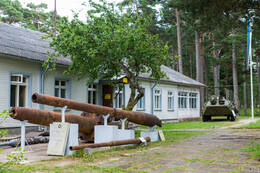
The Military Museum in Hiiumaa is located in the former Tahkuna border guard cordon. The museum's pride is its collection of coastal defense artillery barrels - 180 mm, 130 mm and 100 mm gun barrels are represented here. The outdoor exhibition features armored personnel carriers BTR-70 and BRDM-2, ZIL-157, GAZ-66 and other vehicles, civil defense shelters, a border guard cutter, sea mines, an anti-tank gun, a border guard observation tower, radars and radio masts. The main building of the museum houses a sea surveillance radar in its original place. Gun ammunition and shells, helmets, hats and uniforms, communications equipment and civil defense equipment are on display.