


Courland Fortress and National Partisans
Īle National Partisan Bunker
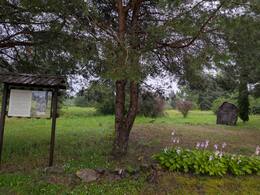
The bunker is located in the Īle forestry of Zebrene Rural Territory, at the turn-off from the P104 Biksti-Auce Road.
The Kārlis Krauja Group of Īle National Partisans was formed in 1947. V. Z. Brizga (alias K. Krauja) was appointed the commander of the group. In October 1948, the Krauja Group merged with a group of Lithuanian national partisans. Krauja Group operated in Jelgava District and consisted of 27 national partisans.
In October 1948, Krauja Group built an underground bunker in Lielauce Parish, Jelgava County, not far from the Īle Forestry, 300 metres to the north of the “Priedaišu” house. Its total length, including battle passages, was 45 metres. 70 remote-controlled mines were planted around the bunker. The bunker was equipped with a furnace, a well, a toilet, and a storage room.
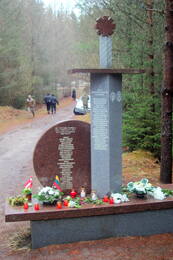
On 17 March 1949, the 24 partisans who were in the bunker at the time fought their last battle against the 760-strong troops of the Ministry of National Security or Cheka. After the battle, 9 members of the group were arrested, while 15 fell in the battle, with eight of them being Latvian and seven being Lithuanian. In 1992, the Home Guards, together with the Daugavas Vanagi (Hawks of the Daugava), unearthed the bunker that had been blown up. A White Cross, a memorial stone and a granite statue were erected at the site.
Inside the bunker, you can see a stove, a table, and narrow benches on which the partisans slept. Information boards and memorial stones with the names of the partisans have been installed at the bunker.
Soviet air force target firing ground in Zvārde
Zvārde landfill is located in Zvārde municipality, Saldus region. It is a former military aviation training ground of the USSR, covering more than 24 000 hectares.
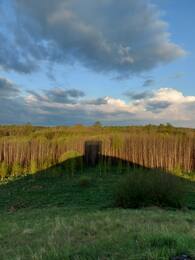
The territory of the former airfield is home to several sites: the Officers' Kurgan, the ruins of the Zvārde and Ķērkliņi churches, the Rīteļi cemetery, the former army base "Lapsas", and others. Until the Second World War, the site of the observation tower was home to the "Vairogi" house. During the construction of the polygon, what was left of the farm - walls, the remains of the apple orchard, and part of the ruins of the Veczvārde manor - was piled together to form a mound and the observation tower was built on it. It was used as an observation point for coordinating the army's training manoeuvres. This place is popularly known as Kurgan. The mound overlooks the former training ground and the wooded areas of Zvārde Nature Park and Nature Reserve. A good place for bird watching. The surroundings of Kurgāns are not landscaped.
Ruins of Ķērkliņu church
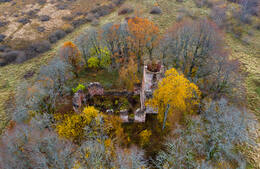
The ruins of the Ķerkliņu Church are located about 5 kilometres north-west of Kokmuiža, near the Ķerkliņu Lake. The church was built in 1641 by Heinrich von Dönhoff (Derkarth), the owner of the Ķerkliņi manor. The original wooden church was replaced by a stone building, under which tombs were built for the dead of the Dönhof and later Kleist families. The tombs were already destroyed during the 1905 riots, but in 1949 the coffins were moved from the tombs to the church. The church was an example of the Kurzeme Baroque style - its carvings were made by the Kuldīga - Liepāja woodcarvers. Although the owners of the manor and the church were at various times plagued by financial problems, the church underwent several reconstructions during its existence. It also suffered during the First World War, after which the parish rebuilt the stonework in 1929 and added an organ in 1934. Unfortunately, the church was damaged during the Second World War and much of it was lost, so it is to be commended that before the church was rebuilt in 1933, many unique pieces of Baroque sculpture were photographed, inventoried and even ended up in the archives of the Monuments Board. With the establishment of the landfill and the eviction of the inhabitants, the church was never restored. Today, the church walls and tower are visible.
Rīteļi Cemetery
After the airfield was established in this area in 1953 at the request of the USSR Ministry of Defence, the Zvārde Church, the Ķerkliņi Church and the Rīteļi Cemetery were actually located in the centre of the airfield - next to an artificial airfield with access roads and defence positions, which was used as a target by Soviet pilots. Planes flew here from airfields in Latvia and elsewhere in the Soviet Union. In less than 40 years, the church, the cemetery, the former manor house and dozens of surrounding buildings were reduced to ruins. Today, the site is cared for by the Saldus Martin Luther Church. The surrounding area is still contaminated with unexploded ordnance and it can be dangerous to walk off the roads.
Barbarism reached its peak in 1988, when the Rīteļi cemetery with its graves and monuments was bulldozed.
On 21 July 1990, in one of the first actions in which the Latvian population demanded that the USSR army leave the territory of Zvārde, a protest rally was held in Saldus, after which people went to the Rīteļi cemetery. The rally participants were allowed into the landfill site, and they cleaned up the cemetery a bit and dug white crosses.
The landfill continued to be used until 1992 and even as late as March 1992 a plane taking off from Lielvārde crashed in the landfill for unknown reasons. The Latvian Defence Forces started demining the site in May 1993, after the withdrawal of the Russian army. In 2008, Zvārde residents installed a memorial stone "Forgive us for not saving you" in the Rīteļi cemetery.
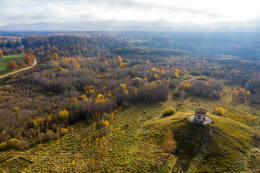
Soviet Army Observation Tower (Kurgan of Officers)
The "Officers' Kurgan" is located less than a kilometre from the ruins of Zvārde Church. The Kurgan is made of the ruins and remains of the surrounding houses and manor house, which have been bulldozed together. An observation tower was built on the kurgan. According to the inscription, the present tower was built in 1981. The tower was used to record bomb hits. The training bombs had a reduced explosive content, so their hits had to be watched more carefully. Unexploded bombs were neutralized immediately, but not all could be found.
The remains of the tower can be seen here today - the brick walls. As the barrage is relatively high, you can even see the Lithuanian oil refinery in Mažeikiai on a clear day.
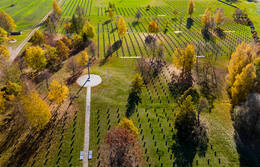
Saldus German Soldiers' Cemetery
The Saldus German Soldiers' Cemetery is located on the Saldus–Ezeres highway. The cemetery, which covers an area of 8 hectares, contains the remains of around 25,000 German soldiers, as well as some Latvian legionnaires. Reburials have been taking place since 1997.
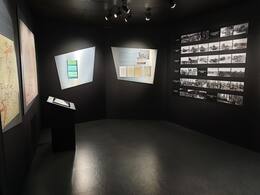
From May 1 to October 1, an exhibition about the battles of Courland can be viewed in the memorial room. During this period, the memorial room is open on weekdays from 9:00 to 17:00, and on Saturdays and Sundays a guide is also working in the cemetery. Registers of soldiers buried in the Saldus German soldiers' cemetery and soldiers who fell throughout Latvia are also available.
Ezere local history repository “Muitas Nams” (Customs House)
The Ezere Customs House is located in Ezere near the Saldus-Mažeikiai highway at the Latvian-Lithuanian border. The act of surrender of the German Army units ‘Kurzeme’ (Kurland) surrounded in the so-called ‘Courland Pocket’ was signed in this building on 8 May 1945. It is believed that World War II actually ended in Ezere. The customs house has an exhibit covering the events of the end of World War II and exhibits detailing the history of Ezere parish from ancient to modern days. In the morning of 7 May 1945, the commander of the Leningrad Front, Marshal L. Govorov, sent an ultimatum to the command of the army group ‘Kurzeme’ to lay down arms. The act of surrender was signed by the involved parties on May 8 and it detailed the procedure of surrender, weapons collection points, documents and information to be submitted and other practical measures.