



National partisans on the border of Latvia and Estonia
Day 1.
140 km
Stompaki – Alūksne – Ape – Vēru
Practical info
- Start : Stompaku swamp.
- Finish : Veru.
- Duration : about 4 - 5 hours.
- Additional options : The route can be supplemented with a visit to the highest point in the Baltic States – Great Munamegis with an observation tower.
- Educational programs : military heritage in the Alūksne Regional Museum , theatrical-educational performance with participation "Five Fate Stories" , Museum-pedagogical lesson "In the Name of the Motherland" .
Sights
National partisan headquarters in the nature reserve “Stompaki Swamp”
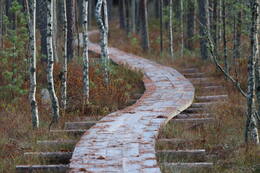
During World War II, one of the largest national partisan camps in the Baltic states was situated in Stompaki Swamp. Today, the territory is included in the nature reserve “Stompaki swamp”. The settlement sites located on the islands in the swamp can be reached via a marked footpath.
In early 1945, about 350 to 360 people, including 40 to 50 women, lived at the camp of National Partisans in Stompaki Swamp. The camp consisted of 24 residential bunkers – buildings that were half-immersed into the ground and could accommodate 3–8 people. There was a bakery, a church bunker and three above-ground rails for horses. Partisans from the camp carried out attacks against officials of the occupation regime. On 2–3 March 1945, the Battle of Stompaki took place here – the largest battle in the history of Latvian national partisans. The 350–360 partisans in the camp were attacked by the 143rd Rifle Regiment of NKVD and local fighters of the so-called ‘istrebitel’ (eliminators) battalion – 483 men in total. The battle lasted for the entire duration of the day on 2 March. On the night of 3 March, the partisans managed to break out of the camp and retreat to their previous base camps. The battle resulted in 28 casualties among partisans, while the NKVD force lost 32 fighters.
Today, the site of the Stompaki camp is home to three restored bunkers – a church, a headquarters and a residential bunker – as well as 21 sites of former bunkers. Information boards about the camp and the battle have been installed at the site. Guided tours can be booked.
Alūksne Museum
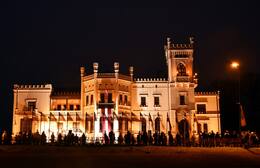
The Alūksne Museum is located in an architectural monument of national significance: the neo-Gothic Alūksne New Castle built in the late 19th century. The museum features an exhibition named ‘Memorial Room for Victims of the Totalitarian Regime’, which tells about the fate of the inhabitants of Alūksne municipality in Siberia and the Far East, while the time periods from prehistory to the present meet in the Alūksne history exhibit ‘Feast of the Ages’. It features a separate section devoted to the contribution of the 7th Sigulda Infantry Regiment to the military, culture and public life. The formation of the 7th Sigulda Infantry Regiment began on 20 June 1919 in the Naukšēni Manor. Initially, a battle group of 22 officers and 1,580 soldiers was formed from the reserve battalion of the Northern Latvian Brigade, and was named the Dankers Division. It was included in the 2nd Battalion of the 3rd Jelgava Regiment. On 23 August, following an increase in the number of companies, it became part of the 7th Sigulda Infantry Regiment. Having taken part in the battles against Bermondt, on 5 January 1920, the regiment was transferred to the Latgale front to fight the Bolsheviks. After the signing of the Peace Treaty with Soviet Russia, the regiment guarded Latvia’s eastern border. The Latvian War of Independence saw the deaths of more than 200 soldiers of the regiment, while 85 were awarded the Lāčplēsis War Order. In 1921, the 7th Sigulda Infantry Regiment was stationed in Alūksne. The regiment’s headquarters were set up in the Alūksne New Castle. After World War II, the castle was taken over by Soviet security institutions. As of the late 1950s, the castle housed various cultural institutions: the Culture and Cinematography Department of the Executive Committee, a pioneer house, a library, a cinema and a museum.
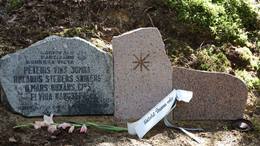
Memorial site of the bunker of the national partisan group “Jumba”
Located in Ziemers parish, in the 66th block of the State Forest.
The memorial was opened on July 10, 2020.
In the second stage of the Latvian national partisan movement, in mid-1948, a group of 4 people - Viks Pētersi, Stebers Rolands, Bukāns Ilgmārs and Kangsepa Elvīra separated from the J. Bitāns-Liepačs unit in the territory of Mālupē-Beja parishes and began independent activities in Ziemera-Jaunlaicene-Veclaicene parishes. The partisan headquarters was near the Estonian border, not far from the Riga-Pskov highway, on a hill, in a well-built bunker.
On March 2, 1950, when the Chekists discovered the bunker, the partisans hid in a barn built of boulders in the “Napke” house on the Estonian side. After a long and intense firefight, on March 3, 1950, the Chekists managed to set the barn on fire. Ilgmārs Bukāns, Rolands Stebers, and Elvīra Kangsepa burned to death along with their newborn daughter. Pēteris Viks jumped out of the barn window and hid in the attic of the house, where he was found and shot. The farm was burned down. The bodies of all the fallen partisans were taken to Alūksne. A memorial sign was erected at the site of the fighters’ deaths in the early 1990s. Elvīra Kangsepa’s daughter, who was born in the burning barn, was named Liesma.
Metsavenna Farm in Võrumaa
Forest Brother Farm is close to the Latvian border in the village of Vastse-Roosa.
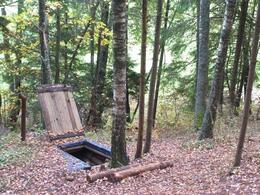
The bunker tourism attraction was opened in 1999, offering visitors a chance to experience the Forest Brothers’ way of life as a chapter in Estonian history. The programme includes searching for Forest Brothers in the hideout, visiting the bunker, learning about real-life events, singing Forest Brother songs with the host and sampling a Forest Brother meal or feast. The main attraction is the bunker, which is lined with narrow pine logs and embedded in the hillside. The bunker is furnished with bunk beds and a small table. These types of bunker were used during the late 1940s and early 1950s by hundreds of brave men in the resistance, burdened by the need to hide from the authorities.
Võru Museum
This museum is situated in the city centre of Võru.
The exhibition showcases the history of Võru County from the prehistoric era to the mid-20th century.
It also provides an overview of the birth of the Estonian Republic and the events of the War of Independence in the county. Moreover, the museum boasts one of the most detailed displays on the Forest Brothers in Estonia, including a replica of the interior of a Forest Brother bunker.
Exhibitions on a variety of subjects are regularly displayed in the exhibition hall, where history-themed museum courses can be attended.
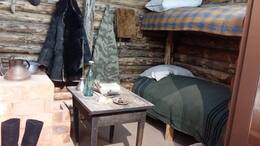
Võru County Museum