


Coastal defense structures and fortresses in Liepāja and Klaipėda
Day 1.
105 km
Karosta – Liepaja - Rucava - Palanga - Klaipeda
Practical info
Excursions and educational programs must be booked in advance and a specific time must be reserved.
- Start : Karosta.
- Finish : Klaipeda
- Additional options : In Klaipėda you can take a ferry to the Curonian Spit and visit the Maritime Museum, which is located in a fortress built by the (Prussian) government in the second half of the 19th century.
- Educational programs : in Redan ( “Mystery Island Redan” , “Redan” ), in Karosta Prison (“ Spy game “Escape from the USSR” , show “Behind Bars” , tour with show elements and tour of Karosta Prison ).
Sights
Redan of Karosta Fortifications
Redans, or Redana Fort, is located in Karosta, 14. novembra Street, about 1.5 km from the Northern Forts, in the nature reserve "Tosmare".
Historically, redans were elements of fortifications where longer sections of fortress walls were divided into shorter sections by building V-shaped positions facing the enemy, which allowed for better protection of the fortification wall. Karostas Redan is a late 19th century Liepaja Sea Fortress, projecting towards Lake Tosmare. As the fortress lost its fortress role, the fortifications and forts around it were partially blown up and rendered unusable. However, Redan remained almost intact.
In November 1919, after the failure at Riga, Pavel-Bermont Avalov's forces launched an intensive attack on Liepaja. The battle was also fought at Redan, where 80 soldiers of the Liepaja Military Port Commandant's Office under the command of Lieutenant Commander Radzins fought. In a swift attack on 14 November, the Bermontians managed to take Redan. This was followed by a counter-attack by Latvian troops and Redan was retaken.
In June, July and August, a knowledgeable guide will be waiting at Redan every day from 11.00-17.00, ready to tell you more about Liepāja Fortress and the historical events in the Karosta.
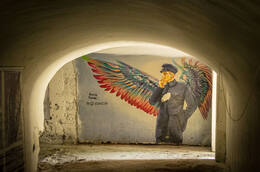
Karosta Military Prison
Karosta Prison is a unique historical and tourist attraction in Liepāja, allowing visitors to learn about the more than century-old history of the military prison and the fates of those imprisoned there. The building was built around 1900 and served as a place of disciplinary punishment for military personnel until 1997.
From the very beginning, it has been a gloomy place for breaking people's destinies and suppressing free spirits. Various unexplained phenomena have been observed in the prison - knocking footsteps, electric bulbs unscrewing themselves, closed cells opening, and apparent images appearing in the corridors.
Today it is an important cultural and historical object that allows you to get to know the military history of Latvia and preserves memories of people's destinies at different stages of history. This is not an ordinary museum tour - it is a story about people's destinies and the harsh reality of history. During the tour, you have the opportunity to see the prison, which has remained almost unchanged since the times of the Tsar. Hear stories about the history of Karosta and unusual events from the daily lives of prisoners. Enter the cells and the solitary confinement, looking into the darkest places of the prison. Get to know the exhibitions about World War II, the Kurelians and the Soviet era.
Karosta Prison is not just a tourist attraction – it is a living witness to history.
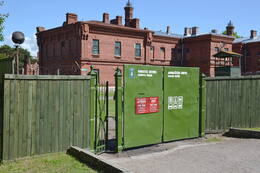
“Memel-Nord” Coastal Artillery Battery
The “Memel-Nord” Coastal Artillery Battery is located in Giruliai, next to the “Olando kepurė” (Dutch hat) on the Baltic Sea coast.
The “Memel-Nord” Coastal Artillery Battery is a part of the coastal defence system of the German Navy, built in 1939 after the annexation of the Klaipėda region to Germany and the beginning of the fortification works of the city. “Memel-Nord” is an integral part of the fortifications of Klaipėda fortifications, consisting of two coastal artillery and six air defence batteries.
The fortifications of the coastal artillery battery were built in two phases: In April and May 1939, temporary fortifications were built for the coastal artillery battery, and at the end of 1939, a decision was made to extend them by developing a permanent position. For this purpose, the coastal artillery battery was equipped with four gun emplacements, equipped with 150 mm SKL-45 guns, fire control posts and an ammunition depot for 150 artillery shells. After the completion of the works, the battery was named “Brommy”.
The battery consists of three structures, with a concrete fire control point in the centre and two artillery blocks with ammunition depots next to it. Since 2002, an exhibition on the history of the Klaipėda region has been opened in one of the artillery blocks.

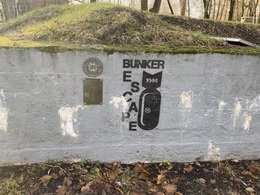
“Escape bunker 1944”
“Escape bunker 1944” is located in the city centre of Klaipėda.
It is a German Army tunnel shelter built in 1944 to help the civilian population of Klaipėda survive the bombing and artillery shelling of World War II. This shelter is believed tohave been built by the Railway Administration of the Reich. The bunker is made of one-metre-thick reinforced concrete walls with an earth embankment on top.
Since 2009, the shelter has been included in the Register of Immovable Cultural Property of the Republic of Lithuania, and the site has been marked with a military heritage label. Long neglected, it was restored in 2016 pursuant to a private initiative. It is now an escape room, a room for solving puzzles, which, consequently, prevents the shelter from deteriorating while creating entertainment for the residents.