


The most secret places in Latvia
Day 1.
74 km
“Corner House” - Skaļupes - Līgatne secret bunker
Practical info
Tours must be booked in advance and a specific time must be reserved.
- Start : "Corner House"
- Finish : Līgatne secret bunker.
- Duration : about 7 hours.
- Additional options : The route can be combined with another sightseeing attraction in Riga or Cēsis.
- Educational programs : in the Soviet secret bunker: “Object X” , “Soviet secret bunker offer for school groups” .
Sights
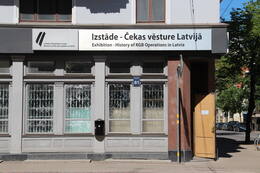
"Corner House" - former USSR KGB Building
The former USSR State Security Committee (commonly known as Cheka) building is open for visitors. Here chekists imprisoned, interrogated and murdered Latvian citizens who were considered opponents by the occupation regime. There is also an exhibit from the Latvian Occupation Museum on the activities of Cheka in Latvia. Guided tours of the prison cells, corridors, basement and courtyard are available. The house was built in 1911 and it is one of the most beautiful buildings in Riga. Called the ‘Corner House’ by the people, it was the scariest symbol of the Soviet occupation regime in Latvia, and also one of the pillars of power of the USSR. Cheka operated from the Corner House during the occupation from 1940 to 1941 and then again from 1945 to 1991. Tens of thousands of Latvians were affected by direct political persecution. The fight against enemies of Soviet rule continued also after World War II. Cheka’s approach towards its operation slightly changed after Stalin’s death. Physical torture was replaced by psychological terror. The majority of Cheka agents were Latvians (52%). Russians were the second largest group – 23.7%. 60.3% of the agents were not members of the Communist Party. 26.9% of the agents had higher education. The system was designed in a way to involve local people and thus have greater control over the society. Staff documents and service records are located in Russia. And these materials have not been made available to Latvian authorities and researchers.
Secret Soviet Bunker in Līgatne
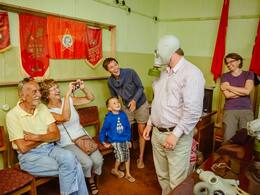
Located in Līgatne parish, Cēsis municipality, the Soviet Secret Bunker lies 9 metres below the Līgatne Rehabilitation Centre building and its adjacent territory. The bunker is open to visitors and offers guided tours, meals in the bunker canteen, Soviet-style parties and the reality game Object X. The purpose of the bunker was to provide the minimum necessary conditions for long-term work for the Council of Ministers of the Latvian SSR, the leadership of the Communist Council of the LSSR and the management of the LSSR state planning committee in the event of a nuclear war threat. The 2,000-square-metre underground bunker was the strongest autonomous structure with all the required and most state-of-the-art equipment of the time, and also one of the most strategically important sites in Soviet-era Latvia in the event of a nuclear war. The site has a protected underground workspace (shelter), a sanatorium-type sleeping block for 250 people, security facilities and a 24-apartment residential house for service staff. All of the authentic underground equipment and plans have been preserved to this day. Highlights include an autonomous power plant with diesel generators and fuel storage, conditioning equipment for air purification with oxygen reserves, water supply and sewerage equipment operating on the submarine principle, a telecommunications unit capable of providing direct contact with the Kremlin in Moscow and autonomous communications with all major services in the country, a unique map with historical names of collective farms, an authentic canteen with typical Soviet-era meals, as well as various Soviet-era attributes and household items.
Places to eat
- In Sigulda and the surrounding area, https://tourism.sigulda.lv/aktula-informacija-par-edinasanas-iespejam-sigulda-3/
- In Ligatne, Ligatne Rehabilitation Center, https://rehcentrsligatne.lv/pakalpojumi/edinasana/