



Resistance to the Soviet occupation regime in Zemgale
Day 4.
99 km
Bauska - Ceraukste parish – Brunava parish – Skaistkalne parish – Kurmene parish – Valle parish
Practical info
* Driving distance: ~99 km. Most of the roads are paved, but access to more remote areas may be via gravel roads.
* There are very few places to eat lunch and dinner along the route. You can order a meal in advance or bring your own food for lunch.
* Memorials can be viewed at any time
* The itinerary is intended as a guide - how to optimally travel around a region or country with the aim of getting to know its military heritage;
* The traveler plans how many of the recommended objects and places he can explore in one day;
* Before traveling, you should check the opening hours of sightseeing places (museums, collections, fortifications, etc.);
* For places where advance booking is required (local guides, private collections, etc.), a visit must be booked, specifying the date and time. If the trip is cancelled, the places booked must be informed;
* Accommodation must be booked in advance. Accommodation may be unavailable during the summer season, especially on the coast. Some catering establishments may not be open during the winter season;
* Choose not only summer for your trip, but also other seasons;
* Visit tourist information centers where you can get additional information, brochures, and maps.
Sights
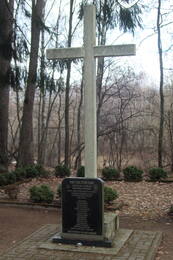
Memorial to Latvian and Lithuanian national partisans at Plūdoņas Cemetery, Ceraukste Parish
The memorial site for Latvian and Lithuanian national partisans was opened on September 11, 2011. It features a white-painted metal cross, at the foot of which is a granite stele with the names of fourteen national partisans and the text: “For You, Fatherland. Latvian and Lithuanian national partisans. Fallen in the fight against the communist occupation in Ceraukste, Panemune, Īslīce and Pabirži parishes (Lithuania) in 1945–1954. Jānis Gudža, Teodors Auniņš, Pēteris Varens, Žanis Strautiņš, Miķelis Dombrovskis, Vilis Krūmiņš, Olģerts Trans, Laimonis Auniņš, Jānis Ulinskis, Jānis Anilonis, Povilas Glinda, Petras Gibrjūnas, Petras Volosklāvičius, Alberts “Voldmerārs” “Director”. Your graves are unknown.”
The memorial site was established by the Latvian National Partisan Association with the support of the Bauska regional government, and the cross was made by precision mechanic Harijs Frīdemans from Dobele with his own money.
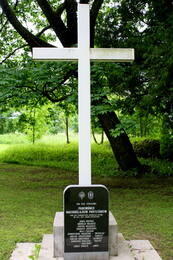
Memorial to Latvian and Lithuanian national partisans in the Mežgaļi School Park, Brunava Parish
The memorial site for Latvian and Lithuanian national partisans was opened on May 25, 2007. It features a white-painted cross, at the foot of which is a granite stele with the names of ten national partisans carved into it and the text: “For You, Fatherland! To the national partisans of Panėmūne. Those who fell in the fight against the communist occupation regime from 1944 to 1952. Jānis Dručka, Andrejs Bojasts, Arvīds Melducis, Augusts Juškēvičs, Willi Fischer, Stanislovas Naudžius – “Mykolas”, Juozas Krikščiūnas – “Karlis”, Juozas Balčiūnas – “Klemute”, Augustas Pareizis – “Kazys”, “Juozupas”, Jonas Sirbike – “Janis””. The memorial site was designed by the Latvian National Partisan Association, based on the project of architect Gunārs Blūzma.
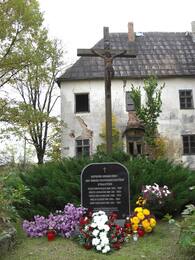
Monument to the Capuchin monks – supporters of the national resistance movement near the Skaistkalne Church
The monument is located near the Skaistkalne Catholic Church and the former monastery building of the Capuchin Order of Friars Minor – a place where national partisans and their supporters hid after World War II with the support of monks. The memorial stele, unveiled in 2011 and consecrated by Pauline Father Jānis Vīlaks, reads: “Monks of the Capuchin Order – supporters of the national resistance movement Kārlis Gumpenbergs OMC (1904-1980), Miķelis Jermacāns OMC (1911-1986), Kārlis Kiselevskis OMC (1906-1979), Miķelis Kļaviņš OMC (1906-1986), Jānis Pavlovskis OMC (1914-2001). They provided shelter and support to national partisans and illegally residing persons in Riga, Skaistkalne and Viļaka in 1945-1947.”
The consecration of the memorial stone dedicated to the Capuchin Fathers took place on October 8, 2011. The stone was consecrated by the Pauline Father of the Skaistkalne Catholic Church, priest Jānis Vīlaks. The event was attended by the Chairman of the Latvian National Partisan Association Ojārs Stefans, the Head of the Skaistkalne Parish Administration Ineta Skustā and other local residents.
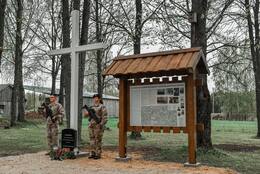
Memorial to national partisans in Kurmene parish
The memorial site for national partisans near the Kurmene parish hall was opened on May 4, 2023, at the site of a monument praising the occupation troops of the USSR, which was dismantled in accordance with the law “On the Prohibition of Exhibiting Objects Glorifying the Soviet and Nazi Regimes and Their Dismantling in the Territory of the Republic of Latvia” adopted by the Saeima of the Republic of Latvia in June 2022. A white-painted wooden cross has been installed at the memorial site, at the foot of which is a black granite stele with the text carved into it: “To the national partisans of Kurmene and surrounding parishes 1944-1953. They will break us, but they will not bend us.”
To the right of the memorial sign, a stand with information about the Kurmene national partisans prepared by Bauska Museum historian Raits Ābelnieks has been installed. The memorial site was established at the initiative of local residents and with the support of the Kurmene parish branch of the Bauska Region Elderly People's Association and the Bauska Region Council.
An active struggle against the Soviet occupation regime and repression by the authorities took place in the eastern part of Bauska region – in Skaistkalne, Kurmene, Bārbele and Valle parishes. In this area, since the second Soviet occupation in the autumn of 1944, there were many men hiding from the authorities. The Mežabrāļi were ready to resist the authorities’ attempts to capture them, so they were provided with weapons and ammunition. At that time, this was easy to do, because there was no shortage of such goods in the former battlefields.
Contacts were established between individual groups and larger partisan units were formed. They were joined by former Latvian Legion soldiers from Kurzeme, who had not laid down their arms and surrendered after the German capitulation, but continued to fight against the occupiers. In the period from July to September, a national partisan unit of approximately 20 men was formed, the core of which was formed by the inhabitants of Kurmene parish. It also included men and young people from Bārbele, Skaistkalne, Valle and the neighboring Mazzalve parish in Jēkabpils district.
Ludvigs Putnieks, born in 1912, from the Kurmene parish "Nagliņiem", became the commander of the unit, his deputy was the former legionnaire Viktors Ančevs from the same parish "Mūrniekim". In the 1930s, L. Putnieks led the Kurmene branch of the patriotic youth organization "Latvijas Vanagi".
This partisan unit carried out several attacks on officials of the occupation authorities in the autumn and winter of 1945, as well as robbed collaborators and state-owned dairies and shops. This was done so that the maintenance of the forest brothers would not be a heavy burden on their already almost completely bankrupt relatives and other supporters. Several fighters of the destroyer battalions, the so-called "istrebikes", and the occupation authorities' inserts in the Kurmene parish Partisan Village Council and the Skaistkalne parish executive committee fell from partisan bullets. Such partisan activity significantly reduced the willingness of the collaborators to carry out the orders of the occupation authorities.
However, an agent was infiltrated into L. Putnieks' partisan group, as evidenced by subsequent events. On January 14, 1946, when V. Ančevs was visiting his mother in "Mūrnieki", militiamen and "Istrebiķe" arrived there to detain him. A shootout broke out, in which the forest brother and his mother died in an unequal battle.
On February 2, units of the 288th Rifle Regiment of the USSR Internal Troops attacked partisan bunkers in the Mazzalve parish forest near the border of Kurmene parish. In a bloody battle against overwhelming odds, Jānis Teodors Meija from Valle parish, Vilips Saulītis from Skaistkalne parish, Arnolds Freimanis from Kurmene parish, Fricis Galviņš from Mazzalve parish and an unknown Riga resident with the nickname Ika or Jonelis fell. The other forest brothers managed to retreat and disappear in the bustle of the battle. No information has been found about the attackers' losses. In subsequent Chekist operations, several other partisans were killed or captured.
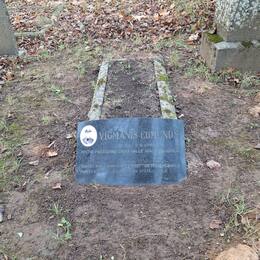
The gravestone of national partisan Edmunds Vigmanis, who fell in 1941, at Valle Cemetery
The gravestone in the Valle cemetery was erected here on July 4, 1941, for the national partisan Edmunds Vigmanis, who was buried here on July 30, 1941, and who fell on June 30 in a clash with Soviet armed formations. The plaque features a ceramic medallion with a photo of E. Vigmanis in a guard uniform and the following inscription: “Vigmanis Edmunds. Born on April 6, 1907. Fell in partisan battles in Valle on June 30, 1941. The countrymen who pass by me are burning with love for the Fatherland. For the beloved Fatherland, I pledge my life.”
After the start of the German-USSR war and the escape of the employees of the Taurkalne parish executive committee, on June 30, local residents gathered at the Taurkalne parish hall in Valle, hoisted the Latvian flag on the flagpole, and formed a 25-man national partisan unit, but only partially armed with rifles and shotguns, led by guard Osvalds Ivanovskis. On the same day, a clash with about twenty Red Army soldiers took place near Jaunbruntālie, during which additional trophy weapons were obtained and five were killed, eight were wounded, and the remaining Red Army soldiers were dispersed. The national partisan, the owner of Jaunbuki, Edmunds Vigmanis, fell in the battle, while O. Ivanovskis and the owner of Bārzdiņi, Jānis Krūmiņš, were wounded.
https://visit.bauska.lv/lv/objekti/redzet-darit/
Places to eat
https://visit.bauska.lv/lv/objekti/est-degustet/
There are few dining options on the 4th day route. The closest one is in Bārbele: https://www.visit.bauska.lv/lv/objekti/est-degustet/edinasana/vieta/kafejnica-barbelite-/
Places to stay
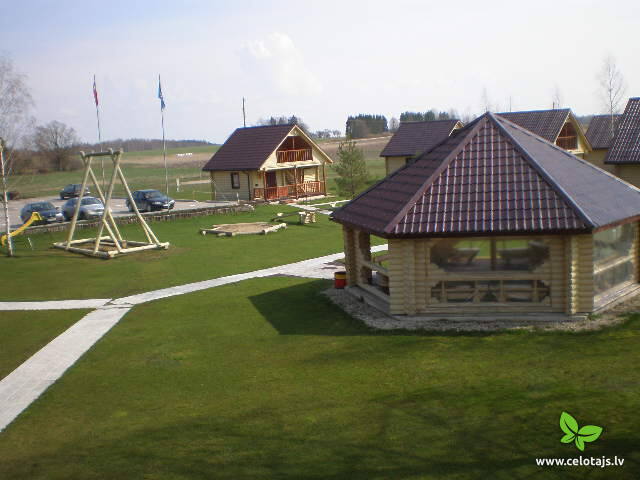
Atpūtas komplekss "Valle"
https://visit.bauska.lv/lv/objekti/palikt-rikot/naktsmitnes/
Nearby to the object on the Ceraukste side: https://www.visit.bauska.lv/lv/objekti/redzet-darit/vieta/lauku-maja-ciruli-/ and https://www.visit.bauska.lv/lv/objekti/redzet-darit/spa-un-labjute/vieta/atputas-vieta-lodenu-pirtina-/
Nearby to the object on the Brunava side: https://www.visit.bauska.lv/lv/objekti/redzet-darit/spa-un-labjute/vieta/glempings-mazie-mezgali-/
Nearby to the object on the Valle side: https://www.visit.bauska.lv/lv/objekti/redzet-darit/spa-un-labjute/vieta/atputas-namins-ozola-stasts-/
Nearby to the object on the Kurmene side: https://www.visit.bauska.lv/lv/objekti/redzet-darit/aktiva-atputa/vieta/jauniesu-centrs-klints-/