



World War II and its Aftermath – Soviet Occupation in Southern Latvia and Latgale
Day 5.
130 km
Rezekne - Malnava - Vilaka - Stompaku swamp - Balvi
Practical info
- The itinerary is intended as a guide - how to optimally travel a region or country, or two countries, with the aim of getting to know their military heritage;
- The driver must plan for himself - how many of the recommended objects and places he can explore in one day;
- Before traveling, you should check the opening hours of sightseeing places (museums, collections, fortifications, etc.);
- In places where advance registration is required (local guides, private collections, other), a visit must be booked, specifying the date and time. If the trip is canceled, the registered places must be informed;
- Accommodation must be booked in advance. Accommodation may be unavailable during the summer season, especially on the coast. Some catering establishments may not be open during the winter season;
- Choose not only summer for your trip, but also other seasons;
- The Latvian-Lithuanian-Estonian borders can be crossed by road freely without restrictions and at any time of the day. When entering from one country to another, you must have an ID card or passport with you;
- Visit tourist information centers where you can get additional information, brochures, and maps.
- To visit objects located in the Latvia-Russia-Belarus border regime zone, you must have a timed pass. For more information, see: https://www.rs.gov.lv/lv/pierobezas-joslas-rezims (LV, EN).
Sights
World War II Bunkers in Malnava and Hitler’s Visit to the Headquarters of the German Army Group North
Hitler’s visit to the Headquarters of the German Army Group North in Malnava and the air defence bunker are mentioned as related sites. However, apart from the location – Malnava Manor, there is no other link between them.
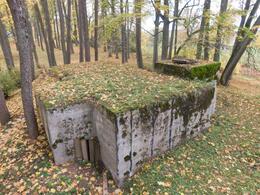
From 12 to 28 July 1941, the headquarters of the German Army Group North, which was waging an attack against Leningrad, was located in Malnava Manor. The reason for the choice of location was practical: Malnava Agricultural School, which was located in a former manor house, had modern facilities: electric lighting, centralised water supply, showers, and sewerage. The headquarters of Group North was located in one of the side blocks of the manor, while the rest of the building continued to operate as an agricultural school. Hitler’s visit to the Group North headquarters in Malnava took place on 21 July 1941. Hitler and his entourage arrived in two Junkers aircraft, accompanied by nine Messerschmitt fighters. The visit only lasted for a few hours and is immortalised both in German military newsreels from the front and in the memories of the pupils of Malnava.
The air defence bunker, located about 70 metres from the manor house, was built at the beginning of 1944 when Soviet aviation began to dominate the airspace in the second half of the war. At that time, the retreat process of German troops was in progress. In 1944, the Headquarters of the German Army Group North stayed in Malnava from February to mid-July.
Private Exhibition “Abrene Rooms”
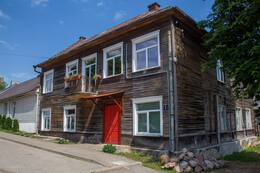
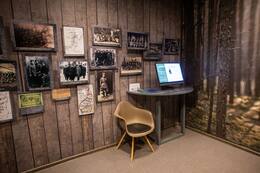
The Private exhibition “Abrene Rooms” is located in the town of Viļaka, in a building with a diverse history. Initially, the building was located on the old Marienhausen market square, later it housed apartments, offices and various shops, and during World War II, it was the Latvian self-defence headquarters, the Gestapo and also the Cheka. Several exhibitions reveal diverse events and historical periods in the town of Viļaka and its nearest vicinity covering the time period from 1920 to 1960 when Viļaka was part of Jaunlatgale, later Abrene, district. The exhibit features items from the national partisan camp in Stompaki Swamp, which are related to the national partisan movement in the Latgale region. Documents and photos associated with the War of Independence are also on display. The latest exhibition is dedicated to the once-famous motocross track “Baltais briedis”.
Vilaka Museum
Viļaka Museum operates in two buildings – the Catholic parish house, built in 1913, which is an important cultural heritage object of the town, and the other building of the museum – a former monastery of Capuchin monks, whose cellars are closely related to the national partisan movement in Stompaki and the Soviet Cheka. According to the memories of the locals, people were held and tortured in these cellars. The old museum building houses several exhibitions, with one of the exhibitions dedicated to the 1920 freedom battles in Northern Latgale, and the second – to the events of the Second World War – the Jewish Holocaust in Viļaka and information about the families who were shot. More information about each family is available based on their street address.
The exhibition is supplemented by information about the national partisan movement in Stompaki – various testimonies, photographs and objects. Visitors can learn about the military heritage sites in and around Viļaka, such as the Freedom Fighters Monument in Jaškova, which was demolished during the Soviet era and restored in 1990, and the stele dedicated to the recipients of the Order of Lāčplēsis. The sound of World War II aircraft is incorporated into the exhibition of the museum, as the German Luftwaffe airfield was located near Viļaka. The museum offers an opportunity to see some memories of the Second World War events in Viļaka, as well as to receive information about the German prisoner-of-war camp in Rači.
Trail and partisan memorial in Stompaki bog
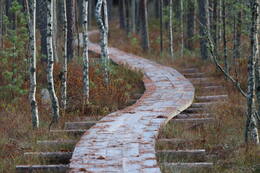
During World War II, one of the largest national partisan camps in the Baltic states was situated in Stompaki Swamp. Today, the territory is included in the nature reserve “Stompaki swamp”. The settlement sites located on the islands in the swamp can be reached via a marked footpath.
In early 1945, about 350 to 360 people, including 40 to 50 women, lived at the camp of National Partisans in Stompaki Swamp. The camp consisted of 24 residential bunkers – buildings that were half-immersed into the ground and could accommodate 3–8 people. There was a bakery, a church bunker and three above-ground rails for horses. Partisans from the camp carried out attacks against officials of the occupation regime. On 2–3 March 1945, the Battle of Stompaki took place here – the largest battle in the history of Latvian national partisans. The 350–360 partisans in the camp were attacked by the 143rd Rifle Regiment of NKVD and local fighters of the so-called ‘istrebitel’ (eliminators) battalion – 483 men in total. The battle lasted for the entire duration of the day on 2 March. On the night of 3 March, the partisans managed to break out of the camp and retreat to their previous base camps. The battle resulted in 28 casualties among partisans, while the NKVD force lost 32 fighters.
Today, the site of the Stompaki camp is home to three restored bunkers – a church, a headquarters and a residential bunker – as well as 21 sites of former bunkers. Information boards about the camp and the battle have been installed at the site. Guided tours can be booked.
Exhibition "North Latgale in the Freedom Struggle" at the Balvi Regional Museum
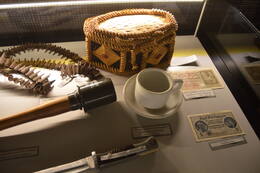
The museum is located in the territory of the Balvi Manor complex, in the building of the former manor barn. The exhibition allows you to look into the history of the Latvian War of Independence from the point of view of Northern Latgale, tracing the history of the formation and activities of the Latgale Partisan Regiment. There are photographs and copies of documents that are not available elsewhere, including the order of 5 July 1919 on the formation of the regiment. The internal orders of the regiment are unique – they were written in Russian between July and October 1919. This reflects the peculiarities of the formation and composition of the regiment as a local unit, where Latvians, Latgalians, Russians, and Jews fought together. The regiment only switched to Latvian in its internal orders after it was fully integrated into the Latvian Army system when it was supplemented by mobilised soldiers from other regions of Latvia. The exhibition also reflects the liberation operation of Northern Latgale, during which the Latgale Division of the Latvian Army liberated the surroundings of Viļaka, Jaunlatgale and Kārsava in battles that lasted from 9 to 15 January 1920. Evidence of both the operation as a whole and the combat activities of the Latgale Partisan Regiment during the liberation of Kārsava are on display in the exhibition.
Places to eat
- In Rezekne, see. visit.rezekne.lv
In Karsava – Family restaurant “Dzīles”, https://www.celotajs.com/en/bakery_dziles
in Riga (Vilaka) “Riga Mills”, https://www.celotays.en/en/e/_Riga_mills
- Prizes sk. visit.balvi.lv
Places to stay
- In Rezekne see visit.rezekne.lv
Rezekne - Karsava - Vilaka - Balvi see latgale.travel
- For awards, see visit.balvi.lv