



Scenes of Soviet Lithuania
Day 2.
125 km
Klaipėda – Kretinga – Salantai – Plateliai – Telšiai
Practical info
- The itinerary is intended as a guide - how to optimally travel a region or country, or two countries, with the aim of getting to know their military heritage;
- The driver must plan for himself - how many of the recommended objects and places he can explore in one day;
- Before traveling, you should check the opening hours of sightseeing places (museums, collections, fortifications, etc.);
- In places where advance registration is required (local guides, private collections, other), a visit must be booked, specifying the date and time. If the trip is canceled, the registered places must be informed;
- Accommodation must be booked in advance. Accommodation may be unavailable during the summer season, especially on the coast. Some catering establishments may not be open during the winter season;
- Choose not only summer for your trip, but also other seasons;
- The Latvian-Lithuanian-Estonian borders can be crossed by road freely without restrictions and at any time of the day. When entering from one country to another, you must have an ID card or passport with you;
- Visit tourist information centers where you can get additional information, brochures, and maps.
Sights
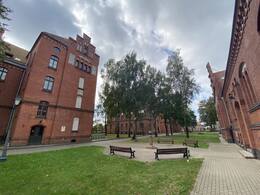
Complex of Barracks in Klaipėda (now Klaipėda University buildings)
Although the complex of barracks in Klaipėda was a military facility, today the barracks have been converted by the University of Klaipėda for its own use, and the former military campus preserves multiple remnants of its military past.
The barracks were built in 1904–1907 under a contract between the Magistrate of Klaipėda and the Prussian Military Administration. The finished barracks complex (architect unknown) consisted of eight main (brick) buildings, six of which have survived to date, and a wooden auxiliary building. The two main buildings were intended for the accommodation of soldiers. Sub-lieutenants and lieutenants used to live in the buildings along what is now Herkaus Manto Street.
From 1907 to 1914, the barracks housed the 3rd Battalion of the 41st “von Boyen” infantry Regiment, which fought on the Eastern Front during World War I and, in 1916, at the famous Battle of Verdun. From 1919–1920, the barracks were used by the volunteer battalion of the 41st Infantry Regiment of the Prussian Volunteer Corps, which was being formed at the time, as well as one battalion of the 223rd Regiment and one battalion of the 103rd Regiment that were sent to Klaipėda. From 1920–1923, the barracks belonged to the 21st Infantry Riflemen Battalion of the French Army, from 1923–1934 – to the 7th Infantry Regiment of the Duke of Žemaitija Butigeidis of the Lithuanian Army, and from 1934–1939 – to the 6th Regiment of the Duke of Pilėnai Margiris. The former military town can only be seen from the outside.
Orvidai Homestead-Museum
The Orvidai Homestead-Museum is located near Salantai, on the right side of the road Salantai-Plungė (KK169) (there are information signs).
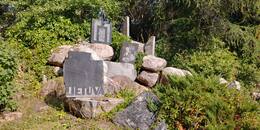
The site was started more than 40 years ago by a family ofstone cutters – a father and son – Kazimieras and Vilius Orvidai (1905–1989; 1952–1992). During the land improvement works, they brought interesting-looking stones scheduled for crushing and centuries-old trees from the surrounding fields to their homestead and used them to create religious monuments. The works created by the Orvidai themselves at their farm homestead, as well as works by other artists displayed there did not conform to Soviet ideological and artistic canons: the works made of stone, wood, metal and old agricultural tools intertwined the symbolism of different religions (Catholic, Pagan, Buddhist). The homestead was also well known to those who did not fit into the reality of Soviet life. The place became a site of refuge and gathering for those who thought differently. The Soviet power repeatedly planned to destroy this environment, however, people managed to preserve it. The Orvidai homestead became very popular during the Lithuanian revival.
An IS-2 tank welcomes visitors at the Orvidai Homestead-Museum. This tank was developed by the Soviet Union during World War II as a response to the German Tiger I. The name IS is an acronym for the Soviet tyrant Joseph Stalin. This tank was formerly located in Salantai as part of the Memorial dedicated to the World War II Soviet burial. In 1991, it was relocated to the Orvidai homestead and became an exhibit.
Cold War exposition
On 31 December 1962, one of the first underground launch complexes for R-12 ballistic missiles in the Soviet Union, the Dvina underground launch complex, was put into operation
in Plokštinė Forest (Plungė district).
Between 1963 and 1978, four R12 medium-range ballistic missiles (SS-4 Sandal) equipped with a 2.3-megatonne nuclear warhead were deployed at the complex. All the missiles were aimed at Western European countries. This complex, together with similar surface-launched missile bases, formed a single Soviet nuclear arsenal in Lithuania, which was capable of destroying the whole of Europe. In its 16 years of operation, not a single missile was fired, despite the declaration of combat readiness during the Prague Spring in 1968.
After the Soviet soldiers left on 18 June 1978, the poorly guarded military facility was vandalised and looted. In 1993, when the complex was handed over to the Žemaitija National Park Directorate, its restoration began. In 2012, the Cold War exposition was opened. Today, this once very secret and guarded place is open to the public. A historical exposition on the Cold War period is on display at the former missile and equipment control room house. To date, it is the only museum in urope where a preserved underground missile launch silo is on display.
Plokštinė Military Town
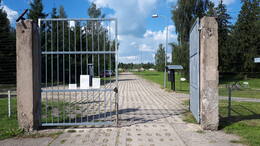
In 1962, one of the first underground launch complexes for R-12 ballistic missiles in the Soviet Union, the Dvina, was put into operation in Plokštinė Forest (Plungė district).
A military camp was set up 0.5 km from the missile launch site. It occupied an area of 12 hectares, and approximately 30 buildings were built here for various purposes, including residential houses (barracks), officers’ headquarters, two canteens, a boiler house, a power station, a medical post, a club, a pig farm, warehouses, garages, and other structures.
The Plokštinė underground missile launching complex was operational until 18 June 1978. The Soviet soldiers left the area, taking only their weapons with them. In 1979, the management of the former military complex was transferred to the Republican Association of Agricultural Recreation Facilities of Plungė District, and the Plateliai Pioneer Recreation Camp “Žuvėdra” was established at the military campus site. The site was reconstructed and adapted to the needs of the camp, which operated until 1990. After the restoration of Lithuanian independence, the Pioneer Camp was closed.
Since 1993, the site has been managed by the Žemaitija National Park Directorate. In 2017, many of the structures on the military campus were demolished due to their state of disrepair. Today, there are about ten buildings left at the site, and visitors may see them from the outside. Information boards about the former buildings and their functions have been installed.
Places to eat
- Klaipeda, klaipedatravel.lt
- Kretinga, visitkretinga.lt
- Plateliai, zemaitijosnp.lt
- Plunge, visitplunge.lt
- Telsiai, visit.telsiai.lt
Places to stay
- Klaipeda, klaipedatravel.lt
- Kretinga, visitkretinga.lt
- Plateliai, zemaitijosnp.lt
- Plunge, visitplunge.lt
- Telsiai, visit.telsiai.lt