

Latgale – the Eastern Border of Latvia
Day 2.
10 km
The day is spent in Rēzekne
Practical info
- The itinerary is intended as a guide - how to optimally travel a region or country, or two countries, with the aim of getting to know their military heritage;
- The driver must plan for himself - how many of the recommended objects and places he can explore in one day;
- Before traveling, you should check the opening hours of sightseeing places (museums, collections, fortifications, etc.);
- In places where advance registration is required (local guides, private collections, other), a visit must be booked, specifying the date and time. If the trip is canceled, the registered places must be informed;
- Accommodation must be booked in advance. Accommodation may be unavailable during the summer season, especially on the coast. Some catering establishments may not be open during the winter season;
- Choose not only summer for your trip, but also other seasons;
- The Latvian-Lithuanian-Estonian borders can be crossed by road freely without restrictions and at any time of the day. When entering from one country to another, you must have an ID card or passport with you;
- Visit tourist information centers where you can get additional information, brochures, and maps;
- To visit objects located in the Latvia-Russia-Belarus border regime zone, you must have a timed pass. For more information, see: https://www.rs.gov.lv/lv/pierobezas-joslas-rezims (LV, EN).
Sights
Border Guard Museum
The museum is located in the premises of the State Border Guard College of Latvia in Rēzekne.
The museum houses an exhibition of the Border Guard History Research Unit, which reflects the chronological development of the Latvian Border Guard from 1919 to the present day. The collected objects and photographs tell the story of the service and everyday life of Latvian border guards in the period from 1919 to 1940, and also about the tragic fate of the border guards after the occupation of the country in 1940. At that time, border guards, along with their relatives, were among the first to be repressed. The museum displays evidence of the service of the restored Border Guard after the restoration of the independence of Latvia – uniforms, equipment, awards and insignia, which have been undergoing continuous development and change even nowadays.
A visit to the Cynology Centre, where you can watch demonstrations by service dogs, is an integral part of the tour.
Appointments must be made in advance.

Free State Treasure House
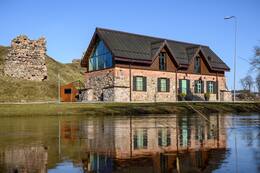
The Treasure House of the Free State is located next to the Rēzekne Castle ruins.
The unique exhibition includes hundreds of different historical testimonies from Latvian and foreign private collections, covering the period from 1918 to 1940, revealing the events in the history of Latgale and Rēzekne. It presents the history of military and civilian awards of the First Free State of Latvia, as well as various organisations related to the activities of state and civic organisations in the period from the Latvian War of Independence to World War II.
The collection of military and civilian awards and insignia of the Latvian Free State on display here is the largest one in Latvia.
The Changing Exhibition Hall is situated on the second floor, where a new exhibition is held at least once per year. To date, visitors have had the opportunity to see a unique collection of porcelain objects, luxury clocks from France and paintings depicting various landscapes of Latgale.
Monument “Vienoti Latvijai” (“United for Latvia”) or Māra of Latgale
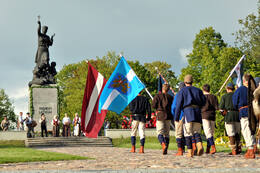
The Monument “Vienoti Latvijai” (“United for Latvia”) or Māra of Latgale is located in Rēzekne. Its central image of a woman holding a cross in her hand symbolises the Latgale region of Latvia, which was liberated from Bolshevik rule in 1920, and its spirit of Christian civilisation.
The monument was initiated by public figures of Latgale in the 1920s. The foundation stone was laid and consecrated on 8 June 1930. In June 1934, a competition for the design of the monument was announced, and the design by Kārlis Jansons won the com petition. The monument was unveiled on 8 September 1939, and the consecration service was held by Bishop Jāzeps Rancāns.
After the Soviet occupation in November 1940, the monument was pulled down. The bronze sculptures were not destroyed due to a shortage of time and the monument was restored on 22 August 1943, during the German occupation. When the Soviet occupation returned, the cross was initially sawn off, while, in 1950, the monument was completely destroyed.
During the Soviet occupation, a Lenin monument was erected instead, which was removed immediately after Latvia regained its independence in 1991.
During the Awakening in 1989, the idea of restoring the historical United for Latvia monument was born. The monument was recreated by the sculptor Andrejs Jansons, the son of Kārlis Jansons, in collaboration with Inta Folkmane, based on his father’s materials and photographs. The restored monument was unveiled on 13 August 1992, during the First World Gathering of Latgalians.
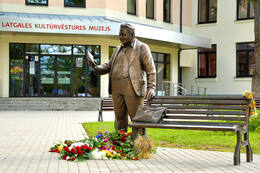
Latgale Culture and History Museum
Three permanent exhibitions are on display at the Latgale Culture and History Museum in Rēzekne. One of them – “Rēzekne laikmetu griežos” (Rēzekne through Ages) – tells the story of the history of the city over seven centuries. A significant part of it is devoted to the events, wars and changes of the 20th century: World War I, the War of In dependence, World War II, the destruction of Rēzekne in 1944 by the Soviet bombers, as well as the prisoner-of-war camp Stalag 347. The exhibition includes a photo booth about the fates of the soldiers from Rēzekne during the war.
During the period of the free state of Latvia, the soldiers of the 9th Rēzekne Infantry Regiment of the Latvian Army stationed in Rēzekne were an integral part of the public life of the city and sporting events, especially during the celebrations of the 11th and 18th of November.
Ančupāni Memorial to the Victims of the Second World War
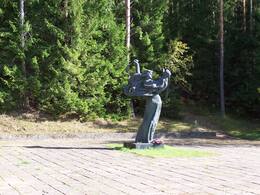
The memorial is located in Ančupāni, in the vicinity of Rēzekne. It was created to commemorate the tragedy of Audriņi – the extermination of civilians during the Nazi German occupation, which took place in 1942 in the village of Audriņi, Makašāni Parish, Rēzekne County.
From the autumn of 1941, several Red Army prisoners of war who had escaped, hid in Audriņi. On 18 December 1941, their whereabouts were discovered and four auxiliary police troops were killed in clashes. On 24 December, 203 residents of Audriņi were arrested and imprisoned in Rēzekne Prison. On 3 January 1942, most of the arrested were shot near the Ančupāni Hills, about 5 km from Rēzekne, and on 4 January, 30 men, arrested in the village of Audriņi, were publicly shot in the market square of Rēzekne, and the village itself was burnt down. The memorial was unveiled on 27 July 1974. It was designed by landscape architect Alfons Kišķis (1910–1994). The evergreen spruce trees on the right side of the road symbolise people lined up to be shot, while the stone wall on the opposite side of the road represents the shooters. In the lowest part – the Valley of Suffering – a boulder-strewn path leads past the mass graves of the people who were shot, ending at a concrete wall with the inscription: “They died so that you might live.” Then, the stairs leading to the Square of Life follow, with the central sculpture “Mother Apple Tree” by sculptor Rasa Kalniņa-Grīnberga (1936) in the square.