



The Great Cross-Border Route - Military Heritage of Latvia and Estonia over 100 Years
Day 13.
175 km
Valmiera–Cēsis–Līgatne–More–Salaspils–Rīga
Practical info
- Driving distance: ~ 175 km
- On this day there is time for 4 sights, including activities offered in at least one of the sights.
- Valmiera audio guide and tourist information visit.valmiera.lv/en/explore/audioguide. Audio guide is available in Latvian, English, Russian, German, Estonian languages.
- The Escape game in Cēsis New Castle is available for 2–5 persons, on previous arrangement.
- Excursion in Cēsis castle complex cesupils.lv.
- Scheduled excursions in the Secret Soviet Bunker www.bunkurs.lv. Group excursions should be booked in advance. The excursion takes ~2 hours.
- The Secret Soviet Bunker offers a reality game “OBJECT X” (at min. 15 persons) www.bunkurs.lv/en/slepenie-piedavajumi. Booking in advance.
- The Museum of Battles in More is open in the summer season from 1 May to 30 October, in the winter season visits should be booked in advance.
Sights
Valmiera
For the first time Valmiera is mentioned in the historical sources in 1323. Until the 13th century this place was in the composition of Talava, inhabited by Latgalians. Construction of Valmiera medieval castle began in the beginning of the 13th century, but in 1283, between the Gauja River and Rate River towered church. Location near to the Tartu-Pskov and Novgorod trade routes greatly facilitated the economic development of the populated area. During the 14th-16th century Valmiera was a part of the Hanseatic League. It suffered greatly from wars, epidemics and fires in 16th to 18th century. In the second half of the 19th century the economic boom started again. It was also facilitated by the building of wooden bridge across the Gauja in 1866 and Riga-Pskov railway opened in 1899. Historic centre is destroyed in 1944. During post-war years, large industrial companies such as - Valmiera glass fiber factory (to this day) are opeating in the town. Today, Valmiera is economic, educational and sports centre of Vidzeme.
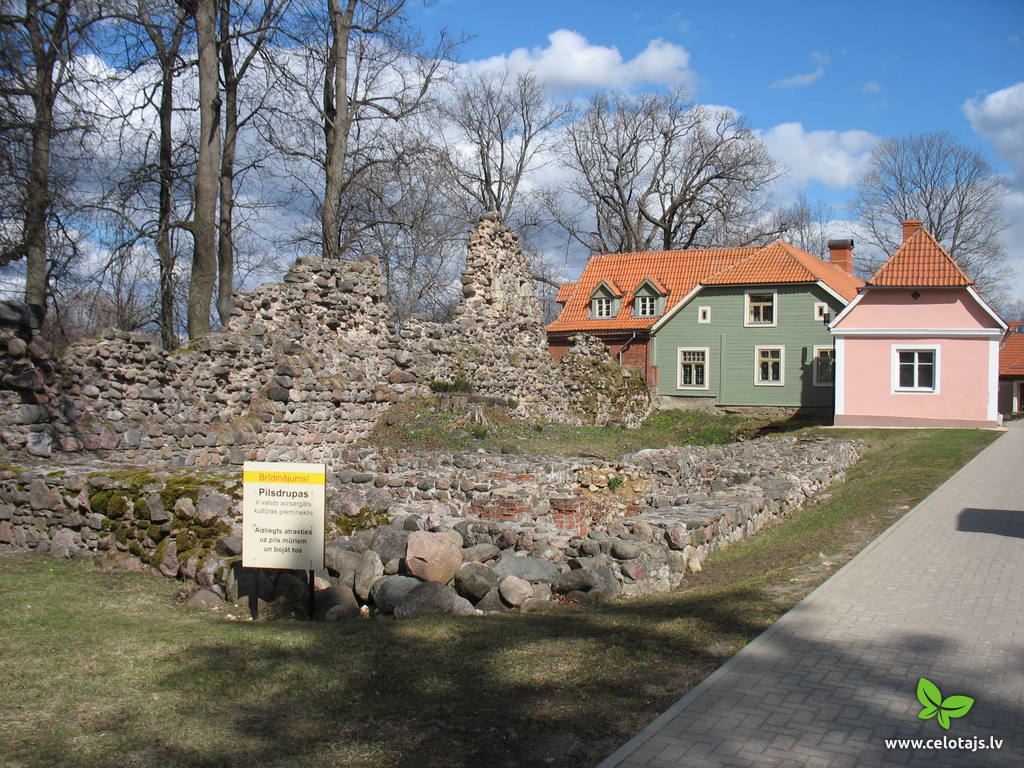
Memorial to the soldiers fallen in World War II
The memorial ensemble in Valmiera was unveiled in 1985. World War II Soviet soldiers who fell in the vicinity of Valmiera and victims of Nazi terror have been reburied in the Brothers’ Cemetery. The authors of the memorial ensemble are sculptors Zigrīda Rapa and Juris Rapa, architects Ēvalds Fogelis, Jānis Lejnieks, Jānis Rutkis and Andris Vītols, and Design Engineer Ivars Veldrums. Limestone from the village of Allaži was used to decorate the memorial ensemble. Its main image is the split linden tree of the Coat of Arms of Valmiera city. Two sculptures on each side of the ensemble symbolise the rhythm of life and death. The figures facing the Gauja river form a semi-circular space, marking the boundary between the past and the present. The main image facing the city is part of an intense arch-shaped form. The figure of a soldier faces the visitors approaching from the side of the city by the bridge, with the diagonal shape formed by the soldier’s hand supporting his deceased companion. On the burial terrace, soldiers have been laid down in rows for those who fought shoulder to shoulder in battle to lie under the same turf. A composition named the Golden Apple Tree lies separately on the lower terrace of the memorial. A granite plaque commemorates the Jews reburied here. Some of the elements, including bronze apples with the ensemble’s message encrypted by the authors, which had been placed under the growing apple tree, disappeared in the 1990s. A QR code next to the memorial gives visitors access to an audio guide with the information available in Latvian, Russian, English, Estonian and German.
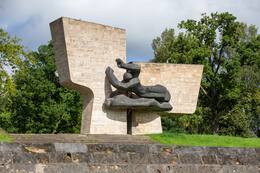
Cēsis history and art museum in the New Castle of Cēsis
The Cēsis History and Art Museum is located in the very centre of the Old Town of Cēsis, in the New Castle. The museum holds a permanent exhibit of history and interiors named ‘Cēsis, a Symbol of Latvian History’, with two thematic sections: the exhibit ‘Red-White-Red Flag in the History of Cēsis and Latvia’ explains the history of the Latvian national flag from the 13th to 20th centuries, the approved national symbol, the flags of Latvian rifle battalions and the traditions of using national colours during the Latvian War of Independence. The exhibit ‘Cēsis and the Latvian War of Independence’ focuses on the founding of the Cēsis Company in December 1918, the joint battle efforts of Estonians and Latvians in the 1919 Battles of Cēsis, the time when, during the Bermondt Affair, Cēsis served as the temporary capital of Latvia for a short time, as well as the history of the Cēsis Victory Monument. In an escape room named ‘Legends of the Battles of Cēsis’, the participants have one hour to find their way out by solving puzzles, making connections and finding hidden objects. The Cēsis Company, one of the first units of the Latvian Armed Forces, was established on 8 December 1918 in Cēsis Castle by Senior Lieutenant Artūrs Jansons. The museum’s exhibit features a memorial plaque dedicated to the Cēsis Company, unveiled on 8 December 1933 at the Cēsis New Castle, which, at the time, served as the headquarters of the 8th Daugavpils Infantry Regiment and the garrison officers’ club.
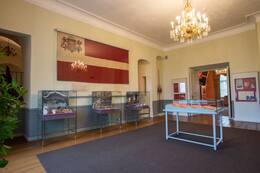
Secret Soviet Bunker in Līgatne
Located in Līgatne parish, Cēsis municipality, the Soviet Secret Bunker lies 9 metres below the Līgatne Rehabilitation Centre building and its adjacent territory. The bunker is open to visitors and offers guided tours, meals in the bunker canteen, Soviet-style parties and the reality game Object X. The purpose of the bunker was to provide the minimum necessary conditions for long-term work for the Council of Ministers of the Latvian SSR, the leadership of the Communist Council of the LSSR and the management of the LSSR state planning committee in the event of a nuclear war threat. The 2,000-square-metre underground bunker was the strongest autonomous structure with all the required and most state-of-the-art equipment of the time, and also one of the most strategically important sites in Soviet-era Latvia in the event of a nuclear war. The site has a protected underground workspace (shelter), a sanatorium-type sleeping block for 250 people, security facilities and a 24-apartment residential house for service staff. All of the authentic underground equipment and plans have been preserved to this day. Highlights include an autonomous power plant with diesel generators and fuel storage, conditioning equipment for air purification with oxygen reserves, water supply and sewerage equipment operating on the submarine principle, a telecommunications unit capable of providing direct contact with the Kremlin in Moscow and autonomous communications with all major services in the country, a unique map with historical names of collective farms, an authentic canteen with typical Soviet-era meals, as well as various Soviet-era attributes and household items.
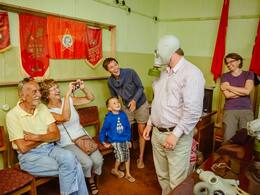
Museum of Battles in More
The museum is located in More, on the side of the V319 motorway. It is dedicated to the Battles of More between the Red Army and the Latvian Legion of the German Army in the autumn of 1944. The exhibit includes a mock-up of the battlefield, weapons, awards, soldiers’ uniforms and military equipment. The Battles of More Museum and Memorial Park was established by former soldiers of the Latvian Legion who participated in the Battles of More. The memorial park features trenches, dugouts and battlefields. The battles in the More area were only part of a large-scale operation of the Red Army Baltic Offensive involving a total of 900,000 soldiers and large numbers of military equipment units. A part of the German Army fortification system where Latvian legionnaires prevented the Red Army’s attempt to break out to Riga was located in the vicinity of More. This allowed the German Army to withdraw its forces from Estonia and avoid defeat. Red Army leaders expected the enemy’s resistance near More to be short-lived and stubbornly continued its unprepared and uncoordinated attacks, suffering heavy losses. Local advantages and the combat capabilities of the Latvian legionnaires played a significant role in the subsequent course of the war. More is home to the Latvian Legionnaires’ Brothers’ Cemetery and a Red Army Soldiers’ Cemetery.
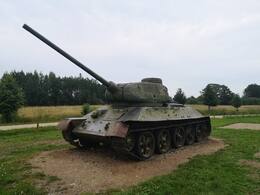
Salaspils Memorial Ensemble
Salaspils Memorial and historical exhibit is located in Salaspils municipality, 1.2 km from the Riga-Daugavpils A6 highway. The Salaspils Memorial was unveiled in 1967 on the site where during World War II the Salaspils Camp was once located. It is a place that was used for Soviet propaganda and is shrouded in myths and half-truths. It is a good representation of the Nazi crimes and Communist ideology that was carried out during each of the occupations. This repressive camp was a part of the German penitentiary system. It had similarities with concentration camps, but it was not the same thing. It was created so that there would not be a disproportionate number of prisoners in Riga prisons. This camp was an “extension of the police prison”. And a variety of people were imprisoned here – Jews, the Red Army prisoners of war, absentees, political prisoners, criminals, prostitutes, members of the Latvian resistance movement, Baltic soldiers in the German Army or police, and others. The camp could hold up to 2,200 prisoners. The main cause of death (~2000) was malnutrition, working conditions, corporal punishment and illness.
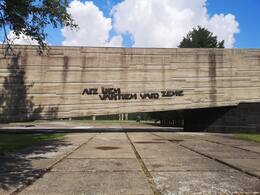
Places to eat
Guest house “Vilhelmine Mill” in Līgatne
The saloon is in the historical centre of Līgatne, alongside a pond, and in a building that was once home to the first Līgatne paper factory.
Latvian cuisine: Vidzeme stroganoff, grilled Kolka herring, grilled pork, Amata trout, potato pancakes with cream, pancakes with jam, beer, kvass.
Special foods: A special dessert.
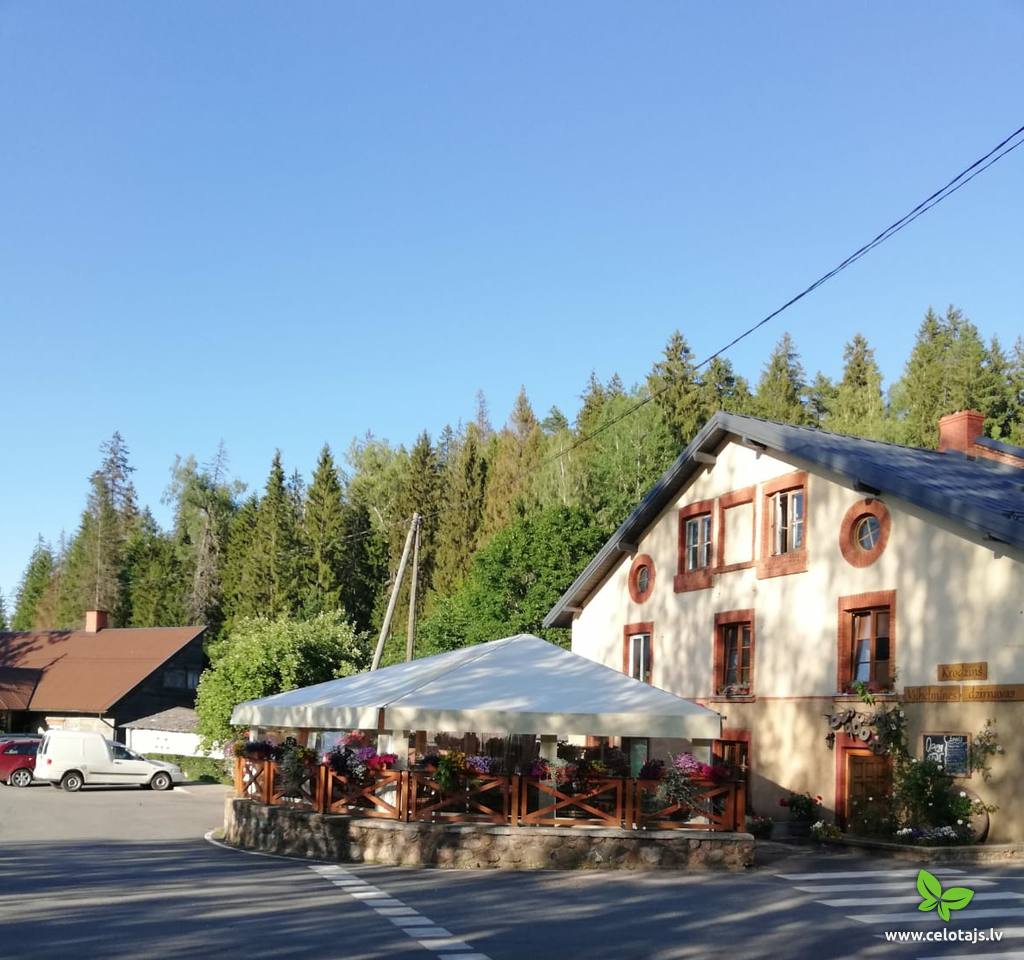
Hotel “Zeit” in Līgatne
Modern hotel with 9 rooms in Līgatne. Each room has a different story and room image. There are rooms such as "Glamor Room", "Worker's Room", "Dreamer Room", "Gardener's Room", "Her and His Room", "Gambler's Room", "Avanturist Room" and "Writer's Room". There is also a café and rooms for seminars available in hotel.
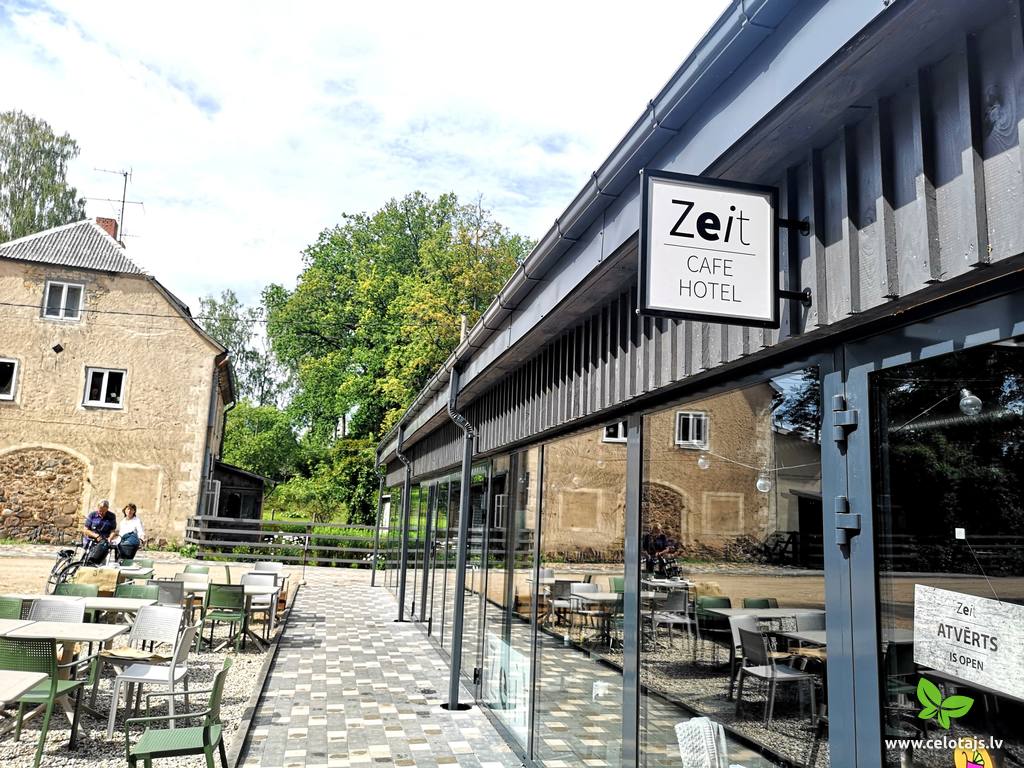
Safari park “More” in More village
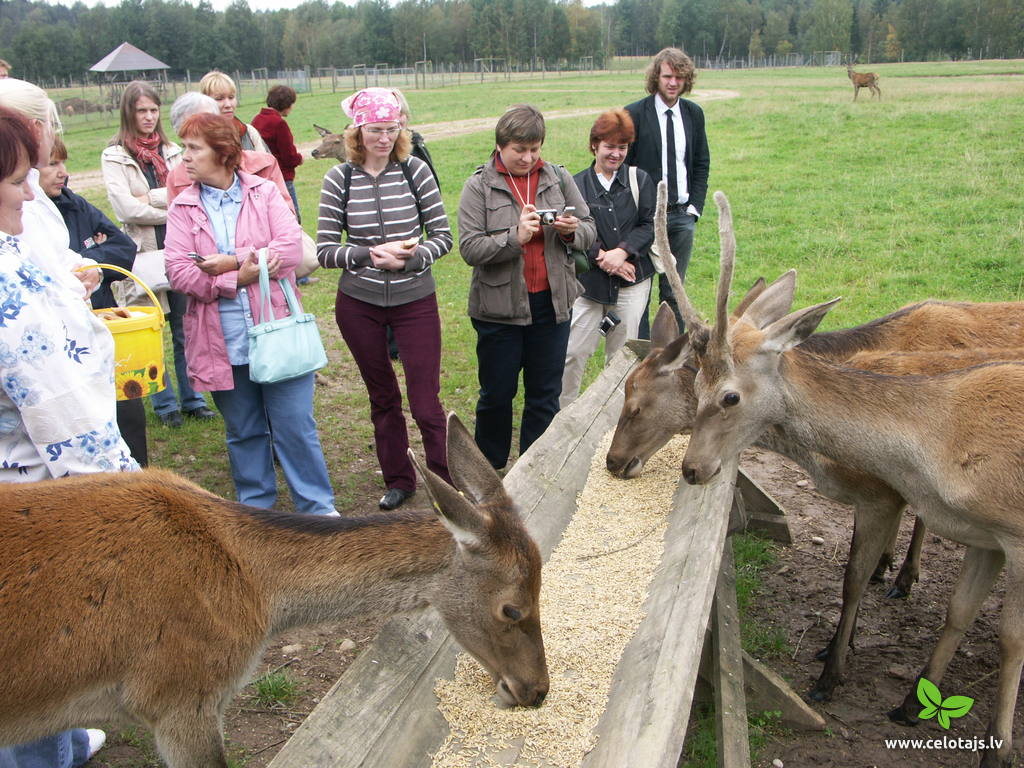
This is a breeding farm for wild animals. On 170 hectares, the family breeds European elks, fallow deer and white elks (some 400 head in all), as well as wild boar. A tour will allow you to look at the animals up close. You can taste venison foods such as shish-kabob and goulash, and you can purchase dried venison, salami and canned sautéed meats.
In Cēsis turisms.cesis.lv/kur–paest–cesis
In Līgatne visitligatne.lv
Places to stay
Guesthouse “Ārpus laika” in Salaspils
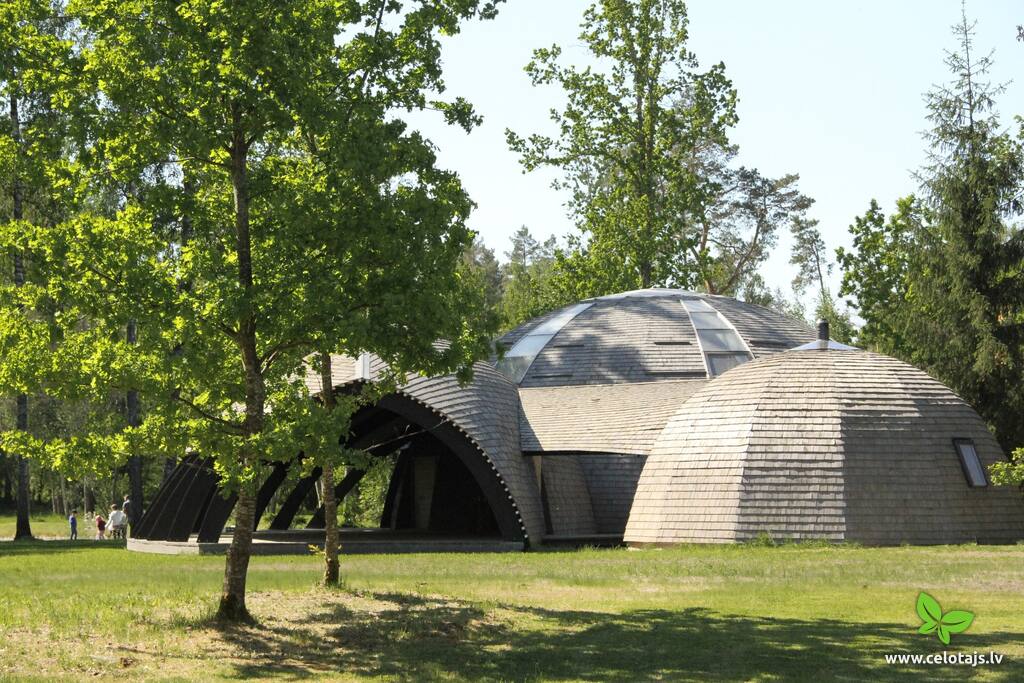
The name of the house is ‘Ārpus Laika’ and it means ‘Beyond Time’. The family has created a landscape park and they practice green living in a dome house designed by themselves. The family also manufactures garden furniture and hammocks. The buildings are surrounded by a beautiful park and a pond full of frogs and fishes. The surrounding landscape of the park with a pergola, a bridge, a forest and fields creates a very tranquil countryside atmosphere that can be experienced just a short drive away from the capital city. The hostess makes wines and offers tasting of different sorts. She also demonstrates cooking of traditional Latvian desserts. The place is also popular for weddings and post-wedding photo sessions.
In Rīga www.liveriga.com