


Battle of Courland 1944 - 1945


The text provides an overview of the emergence of Courland as a separate and isolated battlefield of World War II in October 1944. It describes the Red Army's attempts to break the German Army Group "North"'s land connection with Germany, as well as the successful Klaipėda offensive operation, which resulted in the encirclement of approximately 500,000 German soldiers in Courland. The annotation also outlines the seven-month course of the Courland battles until May 1945, the losses of German forces and the destroyed military cemeteries in the post-war period, as well as the exhumation of the fallen that began in the 1990s.
Kurzeme as a separate and distinct battlefield was established on October 10, 1944. The Red Army had been trying to exploit its success in Belarus since the end of July 1944, where the German Army Group “Center” was destroyed in less than a month. In early August 1944, units of the Soviet 3rd Guards Mechanized Corps occupied Tukums and reached Klapkalnciem on the Gulf of Riga, cutting off land traffic between the Wehrmacht Army Group “North” and Germany. However, the Red Army’s first attempt to cut off traffic was unsuccessful, as the German counterattack restored the land corridor near Tukums by the end of August 1944. The next attempt to encircle the German army began on September 14, 1944, when three Baltic fronts with 1,546,000 soldiers launched an attack in the direction of Riga. This attempt also failed and the Red Army had to change its plans. The third attempt, known as the “Klaipeda Offensive Operation”, was not only successful, but also became one of the greatest achievements of the Red Army during World War II. The 5th Guards Tank Army, having launched its attack on October 5, reached the Baltic coast near Palanga already on the evening of October 10. Approximately 500,000 soldiers of the German armed forces were considered surrounded. According to reports from the headquarters of the 1st Baltic Front, only a small effort was needed to completely liberate the entire Baltic coast. However, the fighting in Courland continued for another seven months and Courland became a symbol of the end of World War II. During the seven months of fighting until May 1945, the German armed forces in Courland lost 154,108 soldiers killed, wounded and missing. The exact number of dead and missing is unknown, but could have reached up to 50,000 soldiers. After the end of the war, the cemeteries of German soldiers were destroyed by the Soviet authorities. The exhumation of fallen soldiers from the battlefields and destroyed cemeteries began in the early 1990s.

Related objects
Saldus German Soldiers' Cemetery
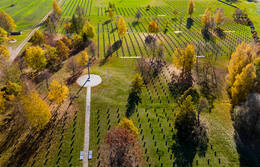
The Saldus German Soldiers' Cemetery is located on the Saldus–Ezeres highway. The cemetery, which covers an area of 8 hectares, contains the remains of around 25,000 German soldiers, as well as some Latvian legionnaires. Reburials have been taking place since 1997.
From May 1 to October 1, an exhibition about the battles of Courland can be viewed in the memorial room. During this period, the memorial room is open on weekdays from 9:00 to 17:00, and on Saturdays and Sundays a guide is also working in the cemetery. Registers of soldiers buried in the Saldus German soldiers' cemetery and soldiers who fell throughout Latvia are also available.