



Audio Guide
The border guards along Latgale’s eastern border from 1918 to 1940
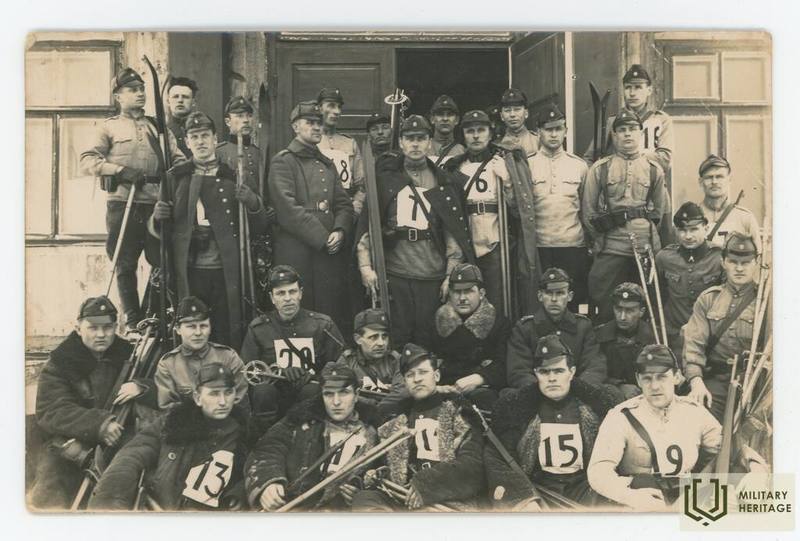
In this audio guide, you'll learn about the guardians of border along Latvia’s eastern border in Latgale – the border guards. You’ll discover what their daily lives were like between the founding of the Latvian state in 1918 and the Soviet occupation in 1940.
Today, thanks to modern technology, border surveillance might seem relatively straightforward. But hundred years ago, guarding the border was a serious challenge that demanded not only physical endurance but also great courage and a strong sense of responsibility. Back then, border guards had to rely entirely on their own skills, experience, and teamwork to protect the country – often in remote and difficult terrain.
It’s important to remember that borders are not just geopolitical lines. They are also home to real people, with their own social lives, cultures, and livelihoods.
We hope these stories will help you appreciate the dedication, professionalism, and bravery of Latvia’s border guards, past and present.
You can view this guide online by visiting the following page:
Visit the GuideRelated objects
Border Guard Museum
The museum is located in the premises of the State Border Guard College of Latvia in Rēzekne.
The museum houses an exhibition of the Border Guard History Research Unit, which reflects the chronological development of the Latvian Border Guard from 1919 to the present day. The collected objects and photographs tell the story of the service and everyday life of Latvian border guards in the period from 1919 to 1940, and also about the tragic fate of the border guards after the occupation of the country in 1940. At that time, border guards, along with their relatives, were among the first to be repressed. The museum displays evidence of the service of the restored Border Guard after the restoration of the independence of Latvia – uniforms, equipment, awards and insignia, which have been undergoing continuous development and change even nowadays.
A visit to the Cynology Centre, where you can watch demonstrations by service dogs, is an integral part of the tour.
Appointments must be made in advance.

Latvia's (Latgale) Eastern Border Route for History Enthusiasts
Nowadays, with modern technology, border monitoring seems relatively simple, but a hundred years ago, border guards faced completely different challenges. Back then, people relied only on their own abilities, experience, and cooperation with colleagues to ensure the security of the country. The borders were long and often difficult to access, especially in border areas like Ludza region. The conditions were also more difficult – forests, swamps, and weather conditions required not only physical endurance, but also great courage and responsibility. During the route, imagine how border guards performed their duties during the first independent state, how long this section seems in comparison.
The route runs along the Latvian-Russian border, the length of the route is 50.13 km. A permit is required, more information HERE . Caution – When driving along the route, be aware that forest roads may be difficult to drive, it is recommended to drive in dry weather, preferably a four-wheel drive car.
Route on Google Maps HERE .
Border regions have always had their own unique dynamics. On the one hand, life there is considered too risky due to various security challenges. On the other hand, it is border guards and other state structures that often contribute to the development of these areas, creating stable communities.
Today, the situation is similar - despite various difficulties, people continue to live, build farms, and develop businesses, as you can see during the route.
Former border guard post , post and memorial plaque at the site of the Līdumnieki guardhouse. At the time of the route's creation (2025), the text on the memorial plaque is not visible (Jaski, Līdumnieki parish, Ludza municipality; GPS: 56.60984, 27.95299)
Regional historical treasure trove in Līdumnieki. A unique collection of testimonies from World War II and the Soviet era, complemented by an exciting narrative. The exhibition was opened in 2004 and is still being updated (Tautas Street 2, Līdumnieki, Līdumnieki parish, Ludza municipality; GPS: 56.59372, 27.99007)
Krivanda cordon site. Preserved shop, border guard residence, and farm buildings (Krivanda, Līdumnieki parish, Ludza region; GPS: 56.53888, 28.05582).
Former border guard post , post and memorial plaque at the site of the Minini cordon. The Minini cordon of the 2nd company of the Zilupe border guard battalion existed until 1940, when it was disbanded and mass arrests took place. Every year on October 9, commemorative events are held at this site (Minini, Līdumnieku parish, Ludza region; 56.510338, 28.090199)
Monument to the fallen of the Battle of Mozuļi. A memorial site on the banks of the Zilupe River for the fighters of the Kārlis Aperāts unit who fell in the Battle of Mozuļi in 1944. At the initiative of the Rēzekne branch of the Daugava Hawks, a white memorial cross was erected here in 1994, and in 2003 a monument with an inscription was unveiled. Every year on July 16, a memorial event is held here (Minini, Līdumnieku parish, Ludza municipality; GPS: 56.509046, 28.091996)
Zilezers – if you drive a little off the route towards the Russian border, you can see Zilezers. Zilezers is a lake on the border of Latvia and Russia. Located in the Zilupe plain of the Mudava lowland in Līdumnieki parish of Ludza municipality and in the Krasnogorodsk district of the Pskov region of Russia; out of the total area of 2.18 km², 0.98 km² is in the territory of Latvia. In Latvia, the lake was called Zilezers, in Russia its name is Синее озеро. The road to the lake can be difficult to pass (Vidri, Līdumnieki parish, Ludza municipality; GPS: 56.510139, 28.124173
The stone “Eye of the Earth”. The stone is unique in its mineralogical composition, as it is formed as a quartz monocrystal. Such large monocrystal boulders have not been recorded in Latvia. The stone is located on private land, therefore, a visit to this object is only available when accompanied by the owner, having previously registered your visit by phone (Tel.: 27056496; Fedorki, Briģi parish, Ludza municipality; GPS: 56.468278, 28.136083)
Opuļi Holy Spring. A holy spring and a place of prayer built by the people on the side of a small white country road surrounded by forests. According to folk tales, the spring water has healing properties (Briģi parish, Ludza region; GPS: 56.42426, 28.15946)
Zilupe. In the very center of the city, at the crossroads opposite the beautiful and modern city park, a two-story red brick building with white window openings is clearly visible. It survived wartime fires and previously served as army barracks. Before World War II, a border guard brigade was also stationed here.
Salvelinki Chapel. Savelinki Chapel is a cultural monument of national importance, a popular place of worship. The entire interior is admirable, as it holds the spirit of the era and the secrets of many contemporaries. The altars decorated with Baroque carvings, created using only a knife, are especially unusual (Kalnu Street 9, Zilupe, Ludza Municipality; GPS: 56.39013, 28.13668)
Former border guard post, post and memorial plaque at the site of the Zilupe cordon (Savelinki, Zaļesje parish, Ludza municipality; 56.388999, 28.137024).
